Where to stay in Beacon Hill, Boston: the four hotels that carry the neighbourhood, what the gas-lamp streets are really like to walk, what a night costs once taxes and parking are added, and who should stay elsewhere.
Best Hotels in Beacon Hill, Boston: where to stay on the city's most photographed streets.
Our hotel picks in Beacon Hill
How this shortlist is put together- The order is not a ranking. There is no first and no last.
- Every bracket is represented, from the cheapest bed in the area to its most expensive room.
- The selection is our editors’ choice. No algorithm, no guest-vote aggregation.
- We do not sell placement on this page.
- We keep one to two properties per group or brand.
- Links open the property’s page on Booking.com so you can compare live rates and dates.
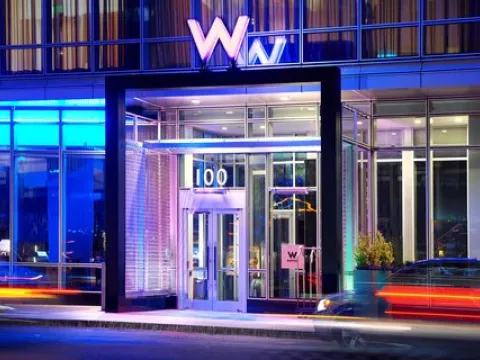
The Whitney Hotel
Luxury boutique · Best for: Staying at the foot of Beacon Hill
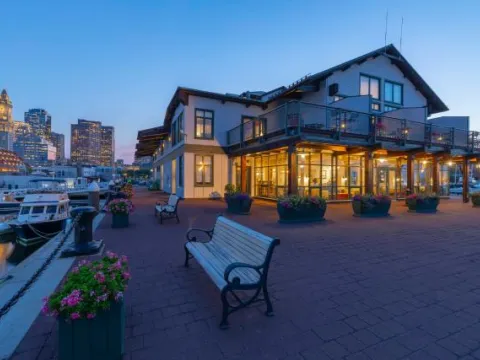
What makes the difference? A small hotel at the bottom of the hill, close to Charles Street and the Charles River esplanade.
See rates and availability for The Whitney Hotel →
The Liberty Hotel
Luxury landmark · Best for: A former 1851 jail with river views
What makes the difference? The building was the Charles Street Jail; the atrium and the Charles River views are what people remember.
See rates and availability for The Liberty Hotel →
Beacon Hill Hotel & Bistro (closed for now)
Townhouse hotel · Not bookable at the moment
The small hotel above the bistro on Charles Street has been closed for renovation since January 2026, according to a notice on its website, and no reopening date has been announced. We have taken it out of our booking picks and will add it back when it reopens. In the meantime, The Whitney Hotel, on the same street, is the closest alternative.
XV Beacon
Boutique luxury · Best for: A discreet address by King’s Chapel
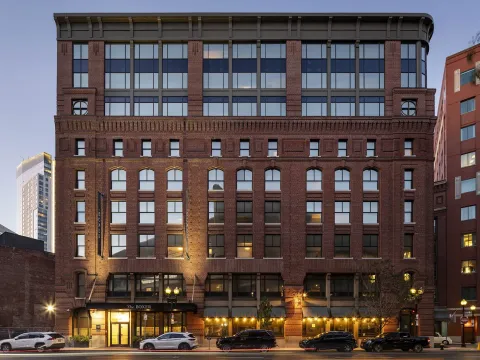
What makes the difference? A converted 1903 Beaux-Arts office building, minutes from King’s Chapel and Boston Common.
See rates and availability for XV Beacon →
Wyndham Boston Beacon Hill
3.5-star · Best for: Mid-range and pet-friendly
What makes the difference? The practical option on this side of the hill, with rates well below the boutique addresses.
See rates and availability for Wyndham Boston Beacon Hill →
Our neighborhood rating: Beacon Hill
Location & sightseeing★★★★½ 4.5/5
Dining & nightlife★★★½☆ 3.5/5
Calm & local character★★★★½ 4.5/5
Hotel value for money★★☆☆☆ 2/5
The editorial judgment of our newsroom, not user votes, not an algorithm. How we rate neighborhoods →
Beacon Hill on one map: the hotels and the walk uphill
The hotels sit at the edges of the hill rather than on it: along flat Charles Street at the bottom, on the West End side by Massachusetts General Hospital, and on Beacon and Tremont Streets by the State House and the Common. We mapped seven of them and measured the walk from each to Acorn Street and to the State House on the street network.
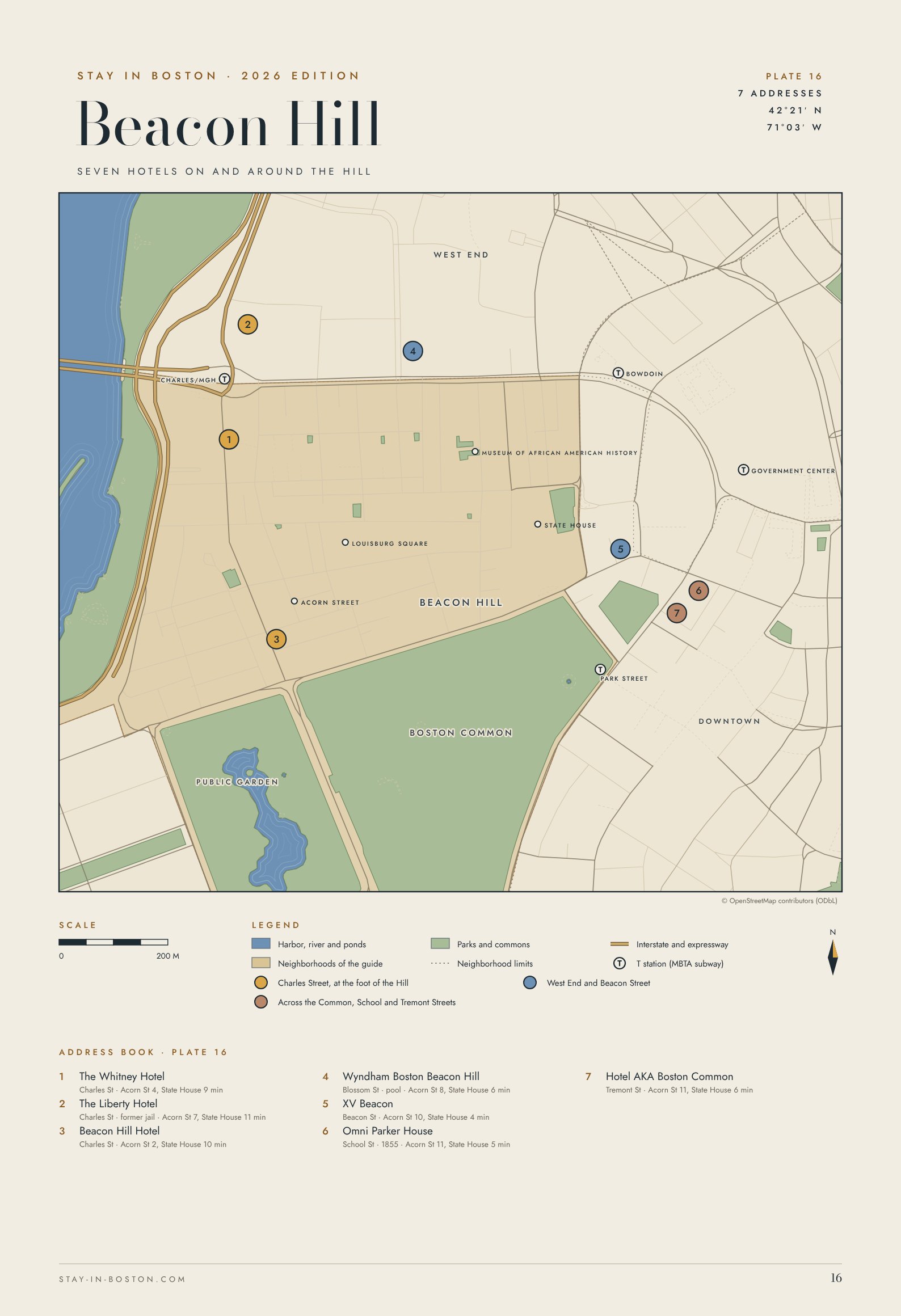
Tap the map to open it full size. Gold pins are on Charles Street, at the foot of the hill; blue pins on the West End side and on Beacon Street; terracotta pins across the Common on School and Tremont Streets. The Beacon Hill Hotel (3) has been closed for renovation since January 2026.
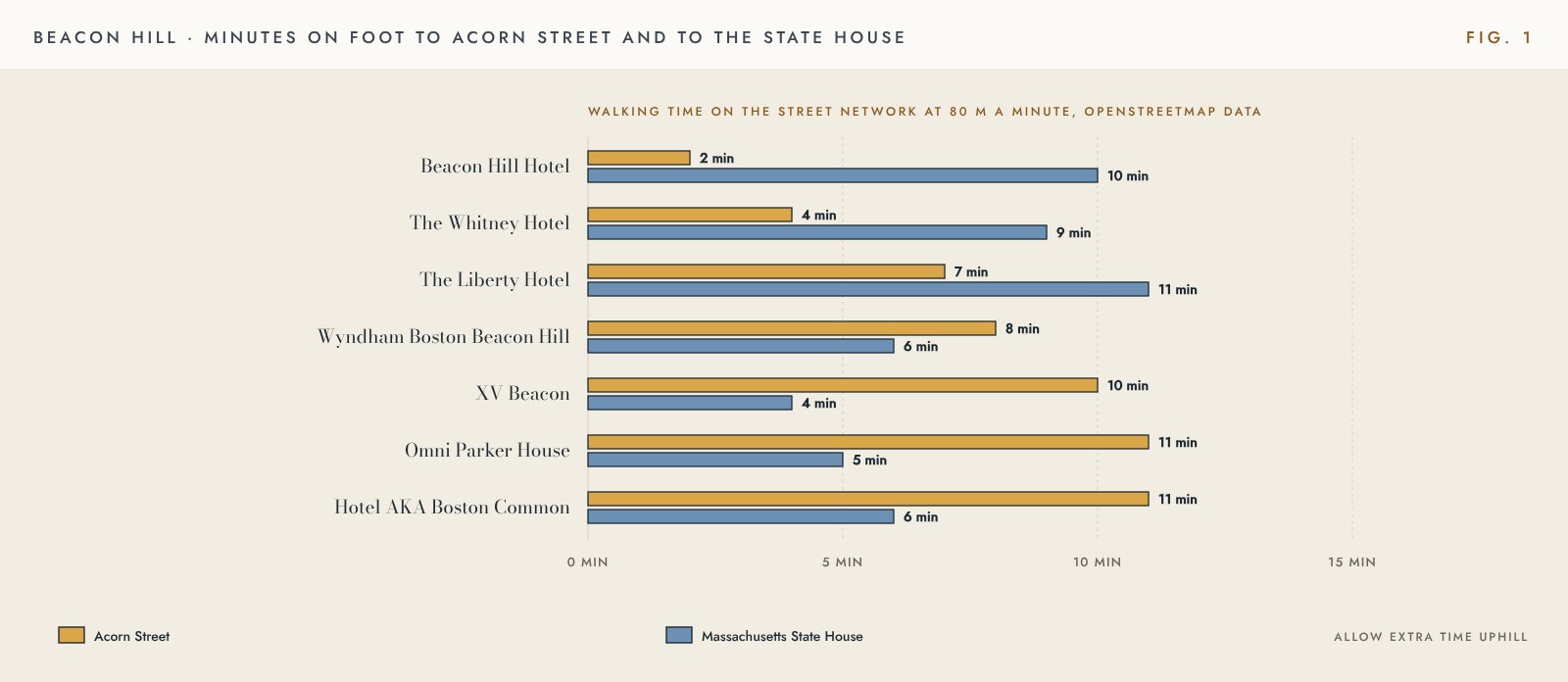
The chart shows the trade-off. From Charles Street, Acorn Street and the steep, cobbled lanes just above it are 2 to 7 minutes away, but the State House is 9 to 11 minutes, mostly uphill. From XV Beacon, the Omni Parker House or Hotel AKA, the State House and the Freedom Trail are 4 to 6 minutes away, but Acorn Street is 10 or 11. Times are for an even walking pace; on Beacon Hill's slopes and brick sidewalks, allow more.
Beacon Hill hotels at a glance: parking, pets and nightly fees
Figures come from the hotels' own pages where they publish them, and otherwise from travel-site listings, marked with an asterisk. Travel-site fees may include tax. None of these hotels has a year-round pool; the Wyndham has a seasonal outdoor one.
| Hotel | Rooms | Parking a night | Pets | Mandatory fee a night |
|---|
| The Whitney Hotel | 65 | Valet $75* | Up to 2, $125 a stay* | About $35* |
| The Liberty | 298 | Valet $75* | Dogs up to 50 lb, $100* | About $29* |
| XV Beacon | 63* | Valet $68* | Dogs up to 30 lb, $85* | None listed* |
| Wyndham Boston Beacon Hill | 304* | Valet $69* | One dog up to 75 lb, $100* | None listed* |
| Omni Parker House | Large | Valet $72 | Under 25 lb, $125 | $35 plus tax |
| Beacon Hill Hotel | 14 | None on site | Ask on reopening | Website shows a renovation closure notice dated January 2, 2026 |
Checked October 18, 2026, from the hotels' official pages first. The seven hotels are those on or at the edge of the hill; walking times are rounded estimates on OpenStreetMap's street network at 80 meters a minute.
Without a car, parking is not your problem. With one, it is the line that changes the bill: hotel valet runs $68 to $75 a night, while the Boston Common Garage, under the Common at the foot of Charles Street, charges up to $38 for 24 hours on a weekday, $14 in the evening or at the weekend when booked online within set entry and exit times, and $5 on weekday nights for cars booked online that enter after 9 pm and leave before 8 am. Beacon Hill's street spaces are mostly for residents with permits, and the city issues no visitor permits.
What to do on Beacon Hill
- Massachusetts State House: free tours on weekdays from 10 am to 3:30 pm, closed weekends and holidays. Self-guided visits for groups of one to ten need no booking, but check in at the Doric Hall desk; guided tours are booked by phone on 617-727-3676. Enter by the General Hooker Entrance on Beacon Street.
- Museum of African American History, 46 Joy Street: open Thursday to Sunday, 10 am to 4 pm, in the African Meeting House, the starting point of the Black Heritage Trail, which you can walk on your own at any time.
- Nichols House Museum, 55 Mount Vernon Street: guided tours of a Beacon Hill house as its last owner left it, on most days of the week (check the museum's schedule); adults $16, children 12 and under free.
- Acorn Street and Louisburg Square: the cobbled lane and the private garden square are best early in the morning, before the photographers; both are residential, so keep voices down and stay off the steps.
- Charles Street: antique shops, cafés and small restaurants on the flat street at the foot of the hill, a few minutes from the Charles/MGH station on the Red Line and the Esplanade footbridge.
Why Beacon Hill is a smart place to stay in Boston
Beacon Hill is the postcard, and unusually for a postcard it is also a functioning residential neighbourhood. Brick row houses, gas lamps, black shutters and brick sidewalks climb the slope between the Massachusetts State House and the Charles River, and almost nothing about the street plan has been straightened since it was laid out. It is small: you can cross it in fifteen minutes: and that compactness is the point.
For a visitor choosing a base, Beacon Hill trades range for character. There are only a handful of hotels here, and none of them is a large convention property. What you get instead is a quiet neighbourhood with Boston Common and the Public Garden at the bottom of the hill, the Freedom Trail running past the State House at the top, and Back Bay a walk across the Garden. Our Boston neighbourhood chooser will tell you in seven questions whether that trade suits your trip.
Atmosphere, streets, and what it feels like to stay here
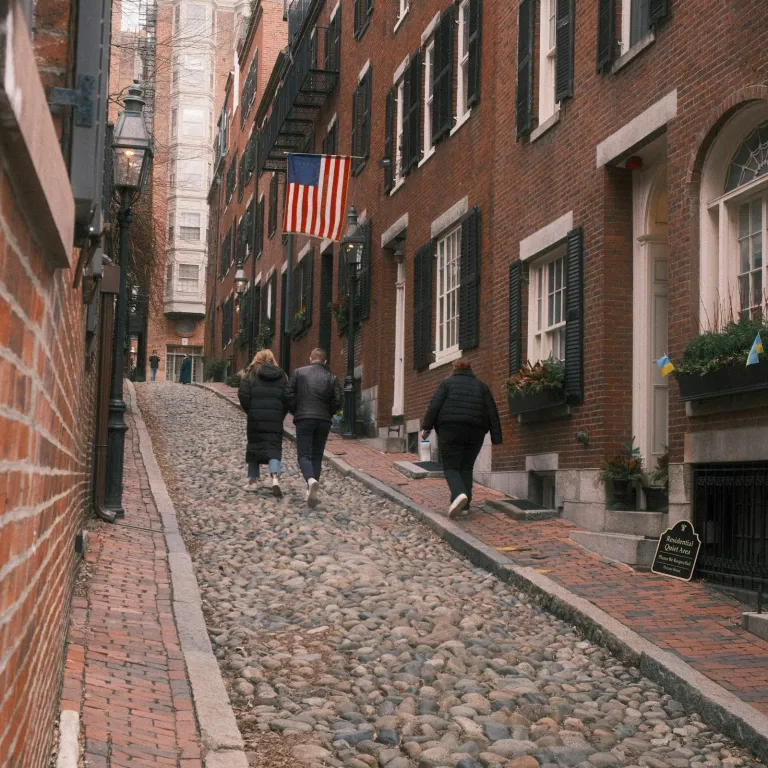
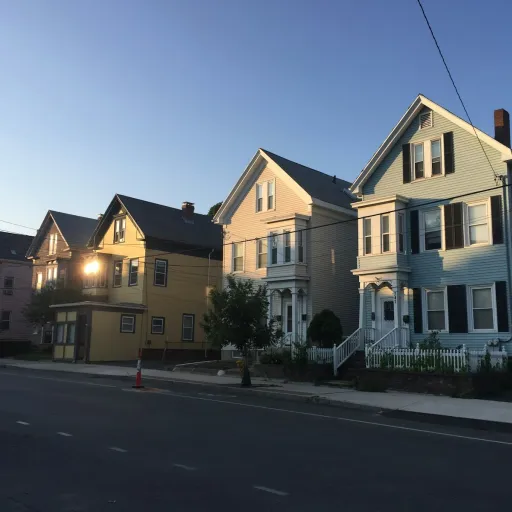
Charles Street is the neighbourhood's high street and the flat one, running along the bottom of the hill with antique dealers, small restaurants and independent shops. It is where you will actually spend your time, and where the hotels are. Above it the residential streets climb steeply: Mount Vernon, Chestnut, Pinckney, and Acorn Street, the narrow cobbled lane that appears in more photographs of Boston than any other. Louisburg Square, a private garden square halfway up, is the quietest address in central Boston.
Two things to know before you book. The hill is a real hill, and the sidewalks are uneven brick: charming to look at, demanding to walk with luggage or with anyone unsteady on their feet. And the neighbourhood goes quiet early: this is somewhere people live, not somewhere the city goes out.
What to expect from hotels in Beacon Hill
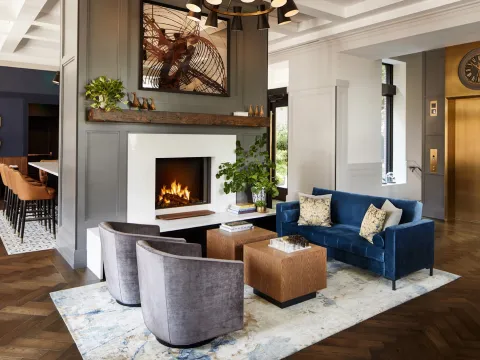
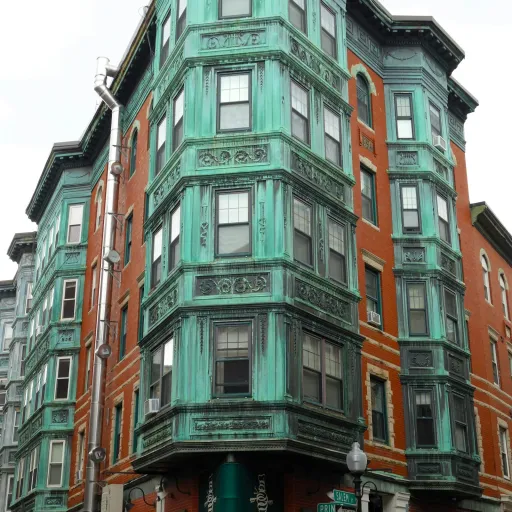
Four properties carry the neighbourhood, and each occupies a building that was something else first: which tells you most of what you need to know about staying here. XV Beacon is a 1903 Beaux-Arts building by William Gibbons Preston that housed the Boston School Committee from 1923 until its conversion to a hotel in 1999. The Liberty, a Luxury Collection Hotel was converted from the Charles Street Jail: the former drunk tank is now the Alibi bar, and the original catwalk is a guests-only lounge.
The Whitney Hotel at 170 Charles Street was designed by Hacin + Associates to match the black-shuttered townhouses around it, and is named for the industrialist Henry Melville Whitney. The Beacon Hill Hotel is the smallest of the four, a handful of rooms above a bistro at 25 Charles Street in the middle of the antique-shop row. Its website still shows a renovation closure notice dated January 2, 2026, so confirm that it has reopened before you plan around it.
There is no budget tier here and no large-format hotel. If your dates are tight, treat the neighbourhood as one option among several rather than a category: all four appear alongside the rest of the city in our list of the fifty hotels that define Boston, where every property was checked against its own site.
What a night in Beacon Hill actually costs
Small inventory and high demand point the same way, and the city adds its own layer. Our Boston Hotel Price Index tracks a fixed basket: the market's average nightly rate, plus 14.95 % in statutory lodging taxes (5.7 % state, 6.5 % city, 2.75 % convention centre), plus one 24-hour downtown garage space. That basket stood at $261.76 in January 2025 and $482.24 in October 2025, an index of 184.2 against a January base of 100, and across the year $301.97 advertised became $385.11 paid.
Parking deserves a separate thought in Beacon Hill. The streets are narrow, resident-permit parking dominates, and hotel parking is valet where it exists at all. If you are driving to Boston, price the car before you price the room, or plan not to have one. The Boston trip budget calculator lets you set every line yourself.
Because there are so few rooms here, the seasonal squeeze bites harder than the citywide average suggests: occupancy across Boston runs at 87.8 % in October against 54.3 % in January according to the figures gathered in our Boston travel data room. In a four-hotel neighbourhood, an autumn booking made late is often no booking at all: see Boston in the fall.
Location advantages: walking, transit, and access
Beacon Hill is central in the literal sense: it sits between Boston Common and the Charles River, with the State House on its crest. The Freedom Trail passes the State House, so the historic core is a walk downhill rather than a journey. Boston Common and the Public Garden are at the foot of Charles Street, and Back Bay begins on the far side of the Garden.
Transit is good for a neighbourhood this quiet. Charles/MGH on the Red Line sits at the bottom of Charles Street, Park Street at the corner of the Common connects the Red and Green lines, and Bowdoin and Government Center put the Blue Line within reach on the downtown side. The Esplanade and the river path are directly across from Charles/MGH. If you want the days planned around this base, our Boston itinerary builder does that.
Who Beacon Hill suits best, and who should look elsewhere
Beacon Hill suits couples, returning visitors, and anyone who would rather sleep in a neighbourhood than in a hotel district. It suits travellers who want the Freedom Trail and the Common on foot and are happy to walk everywhere else. It suits people who value quiet evenings.
It suits you less if mobility is a concern: the hill is steep and the brick sidewalks are uneven. It suits you less if you need choice, a large hotel, a conference venue or a late-night neighbourhood: Back Bay has all of that a short walk away. It suits you less if you want the harbour, the ferries or the aquarium, which belong to the Boston waterfront. And it suits you less if you are driving, for the reasons above.
How to choose the right Beacon Hill hotel for your stay
With four properties, the choice is unusually simple: pick the building. XV Beacon for a converted 1903 civic landmark at the top of the hill; The Liberty for the Charles Street Jail conversion and the largest social scene of the four; The Whitney for a purpose-built hotel that looks like the street it stands on; the Beacon Hill Hotel for something small above a bistro, once it reopens.
Then check two things. Whether the hotel sits on Charles Street, which is flat, or above it, which is not: with luggage that difference is worth more than a star rating. And whether parking is offered at all, because in this neighbourhood it frequently is not.
The rest of our neighbourhood guides are on the Boston where-to-stay index, and the rules behind these pages are set out in how we work.
Compare nearby areas: Beacon Hill has few hotels, so compare it with Back Bay, a flat 15-minute walk across the Public Garden, and Downtown, on the other side of Boston Common, where the choice is much wider.
Frequently asked questions about staying in Beacon Hill
Is Beacon Hill a good area to stay in Boston?
Yes, if you want quiet and character rather than choice. It is central, safe and beautiful, with Boston Common, the Public Garden, the State House and the Freedom Trail all on foot, but it has only a handful of hotels and no budget tier.
How many hotels are there in Beacon Hill?
Four carry the neighbourhood: XV Beacon, The Liberty, The Whitney Hotel and the Beacon Hill Hotel, which has been closed for renovation since January 2026. The Wyndham Boston Beacon Hill, on the West End side of Cambridge Street, adds a larger mid-range option. That small inventory is the main practical constraint on staying here, especially in autumn.
Is Beacon Hill walkable, and is the hill a problem?
The neighbourhood is small and central, but it is genuinely steep above Charles Street and the sidewalks are uneven brick. Charles Street itself is flat. If anyone in the party has trouble with slopes or steps, choose a hotel on Charles Street rather than above it.
Beacon Hill or Back Bay for a first visit to Boston?
Back Bay for a first visit: more hotels, more restaurants, more transit and an easier walk. Beacon Hill for a second visit, or for a couple who want quiet. The two are separated by the Public Garden, about fifteen minutes on foot.
Can I park at a Beacon Hill hotel?
Sometimes, and usually only as valet. The streets are narrow and dominated by resident permits, so parking is scarce and charged nightly. Boston's lodging taxes of 14.95 % and a downtown garage space are both built into our Boston Hotel Price Index basket for exactly this reason.
Which Beacon Hill hotel is closest to Acorn Street?
Among the hotels open in October 2026, The Whitney Hotel on Charles Street, about 4 minutes on foot, then The Liberty at about 7. The Beacon Hill Hotel, 2 minutes away, has been closed for renovation since January 2026.
Can I tour the Massachusetts State House?
Yes, for free, on weekdays from 10 am to 3:30 pm. Self-guided visits for groups of one to ten need no booking, with a check-in at Doric Hall; guided tours are booked by phone on 617-727-3676. There are no tours on weekends and holidays.
Is the Beacon Hill Hotel & Bistro open?
Not at the moment. The hotel on Charles Street has been closed for renovation since January 2026, according to its website, with no reopening date announced. The Whitney Hotel, also on Charles Street, is the nearest alternative.
Other Boston neighbourhoods
Not sure Beacon Hill is the right base for your trip? These guides cover the neighbourhoods travellers most often weigh against it.
See all our Boston hotel guides