Where to stay on the Boston waterfront: Long Wharf, Rowes Wharf, Battery Wharf and Fort Point Channel compared, which hotels sit on which pier, what a harbour-view night really costs, and how the Seaport differs.
Best Hotels on the Boston Waterfront: where to stay when you want the harbour outside the window.
Our hotel picks in the Boston Waterfront
How this shortlist is put together- The order is not a ranking. There is no first and no last.
- Every bracket is represented, from the cheapest bed in the area to its most expensive room.
- The selection is our editors’ choice. No algorithm, no guest-vote aggregation.
- We do not sell placement on this page.
- We keep one to two properties per group or brand.
- Links open the property’s page on Booking.com so you can compare live rates and dates.
Boston Harbor Hotel
5-star · Best for: The classic harbourfront address
What makes the difference? The Rowes Wharf arch is the postcard image of the Boston waterfront, and the marina and harbour walk start at the door.
See rates and availability for Boston Harbor Hotel →
InterContinental Boston
5-star · Best for: Harbour-view rooms on Atlantic Avenue
What makes the difference? Floor-to-ceiling glass facing the water, with the Greenway and the Seaport bridge both a few minutes away.
See rates and availability for InterContinental Boston →
Omni Boston Hotel at the Seaport
4-star · Best for: A big-hotel stay with a pool and terrace
What makes the difference? The largest recent opening in the Seaport, with an outdoor pool and several restaurants on site.
See rates and availability for Omni Boston Hotel at the Seaport →
The Westin Boston Seaport District
4-star · Best for: Convention-centre proximity
What makes the difference? Connected to the convention centre, which makes it the default choice when you are in town for an event.
See rates and availability for The Westin Boston Seaport District →
YOTEL Boston
4-star · Best for: Compact, well-priced rooms in the Seaport
What makes the difference? Small cabin-style rooms at a lower rate than its Seaport neighbours, with a rooftop terrace.
See rates and availability for YOTEL Boston →
Our neighborhood rating: The Waterfront
Location & sightseeing★★★★☆ 4/5
Dining & nightlife★★★★☆ 4/5
Calm & local character★★★½☆ 3.5/5
Hotel value for money★★☆☆☆ 2/5
The editorial judgment of our newsroom, not user votes, not an algorithm. How we rate neighborhoods →
The waterfront on one map: where each hotel sits
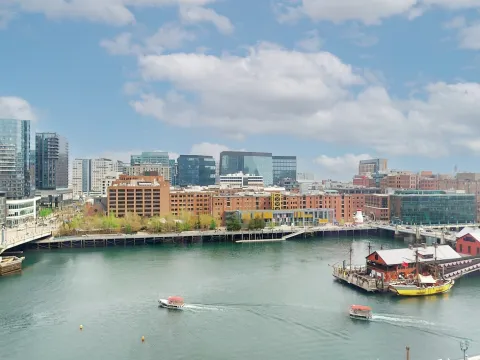
Boston's waterfront runs from Battery Wharf, on the edge of the North End, past Long Wharf and Rowes Wharf to Fort Point and the Seaport. The hotels along it fall into two groups: the old wharves, a few minutes from the Aquarium and the ferries, and the Seaport, newer and closer to the convention center. We mapped ten of them and measured the walk from each to the New England Aquarium and to South Station on the street network.
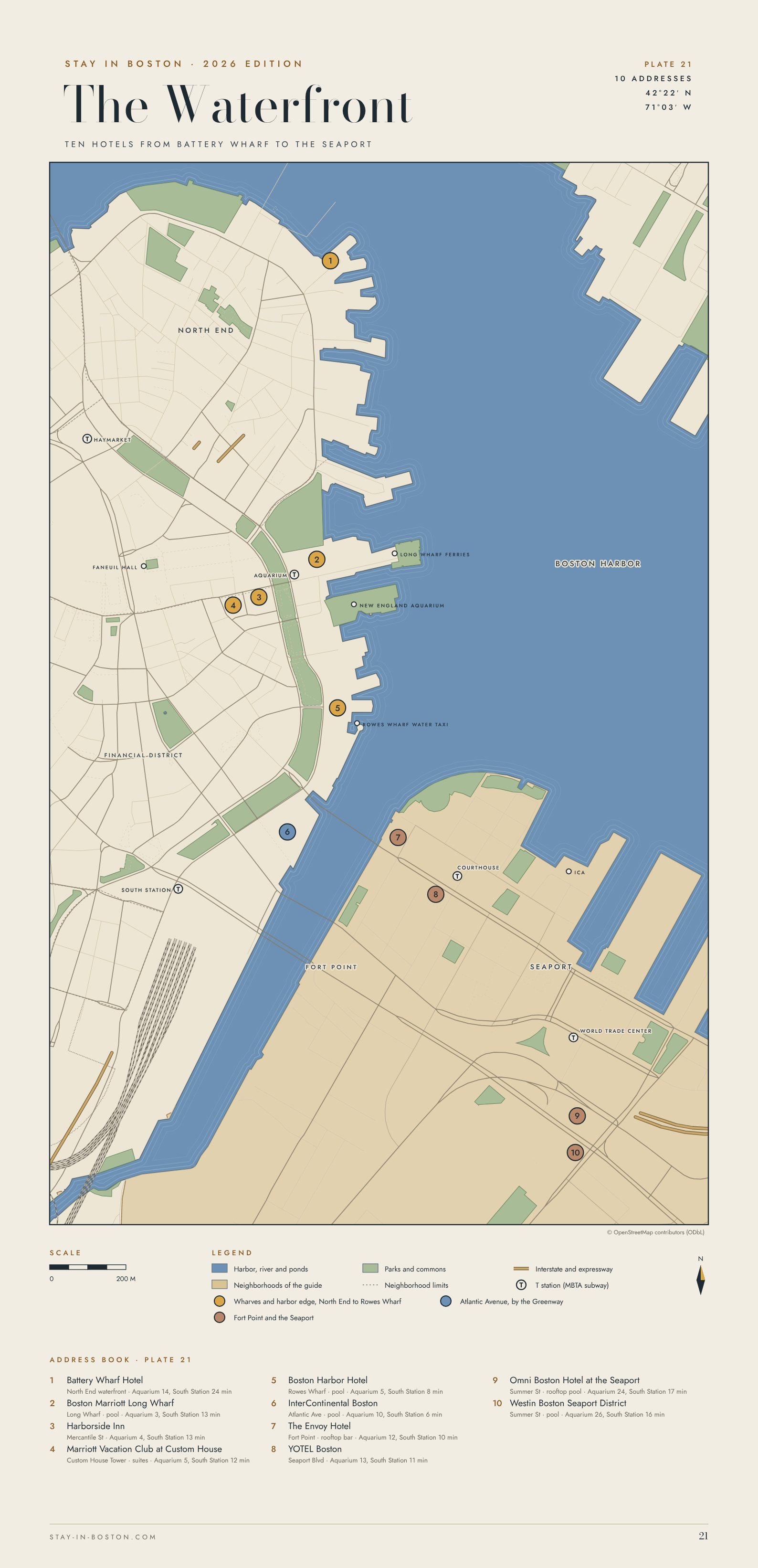
Tap the map to open it full size. Gold pins are on the wharves between the North End and Rowes Wharf, the blue pin on Atlantic Avenue, terracotta pins in Fort Point (The Envoy, YOTEL) and around the convention center in the Seaport (the Omni, the Westin).
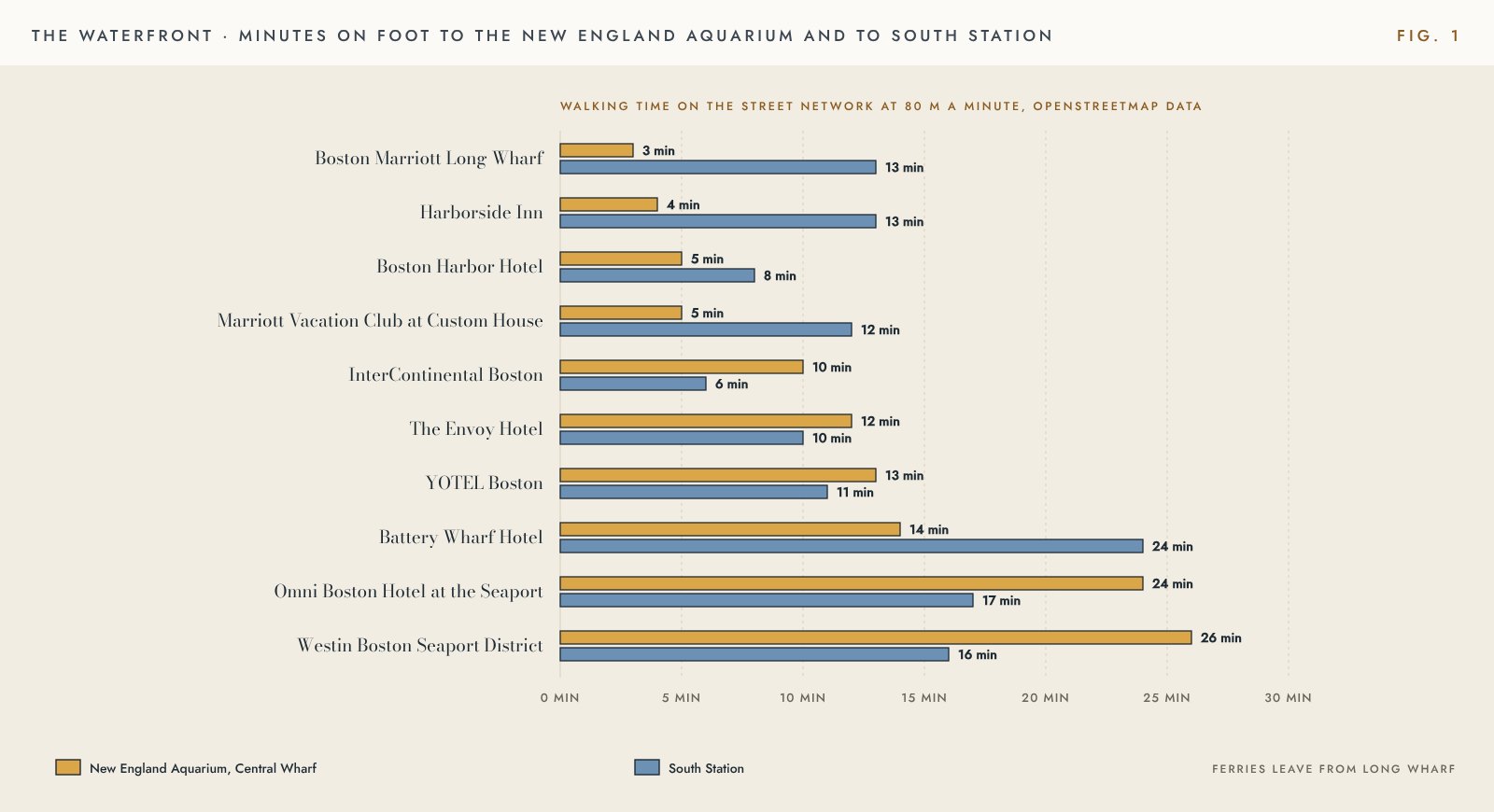
The chart explains the choice. From the Boston Marriott Long Wharf, the Harborside Inn, the Custom House and the Boston Harbor Hotel, the Aquarium and the Long Wharf ferries are 3 to 5 minutes away. The InterContinental and the Boston Harbor Hotel are the closest to South Station, 6 and 8 minutes. From the Seaport hotels, the Aquarium is a walk of 12 to 26 minutes, so pick them for the convention center or the ICA rather than the old harbor. Walking times are rounded estimates on OpenStreetMap's street network at 80 meters a minute, to the Aquarium's entrance on Central Wharf and to the main entrance of South Station.
Which waterfront hotel to choose
- For the Aquarium, ferries and the North End: the Boston Marriott Long Wharf or the Harborside Inn, 3 to 4 minutes from Central Wharf.
- For a classic harbor hotel with a pool and no resort fee: the Boston Harbor Hotel at Rowes Wharf.
- For a family needing space: the one-bedroom suites at the Marriott Vacation Club at Custom House.
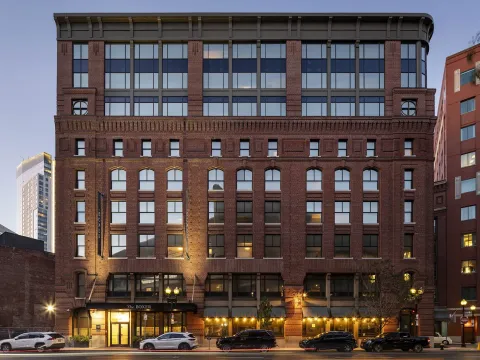
- For the convention center or the ICA: the Westin or the Omni in the Seaport, or The Envoy in Fort Point for a smaller hotel with a rooftop bar.
Waterfront hotels at a glance: pools, parking and nightly fees
Figures come from the hotels' own pages where they publish them, and otherwise from travel-site listings, marked with an asterisk; travel-site fees may include tax. Checked October 19, 2026. Pet fees are per stay or per night as shown.
| Hotel | To the Aquarium | Pool | Parking a night | Pets | Mandatory fee a night |
|---|
| Battery Wharf Hotel | 14 min | No | Valet $60 | $150 a stay | $35 plus tax |
| Boston Marriott Long Wharf | 3 min | Indoor | Valet $73 | No pets | $35 plus tax |
| Harborside Inn | 4 min | No on-site pool listed | Discounted off-site parking | No pets | None (no incidental fees, per the hotel) |
| Marriott Vacation Club at Custom House | 5 min | No on-site pool listed | Valet $60 | No pets | No destination fee |
| Boston Harbor Hotel | 5 min | Indoor | Self $55, valet $70 | $100 per pet per night, two at most | None |
| InterContinental Boston | 10 min | Indoor lap pool | Valet $65 | One dog up to 25 lb, $150 a stay | $39 a day, waived on some rates |
| The Envoy Hotel | 12 min | No (rooftop bar) | Valet $75* | $100 a stay* | $30 |
| YOTEL Boston | 13 min | No | Valet $80 | No pets | $45 plus tax |
| Omni Boston Hotel at the Seaport | 24 min | Rooftop, heated, all year | Self $60, valet $70 | $125 a stay | $35 plus tax |
| Westin Boston Seaport District | 26 min | Indoor, heated | Self $55, valet $65 | $50 a night, up to two of 50 lb | $40 plus tax |
Two things stand out. The Boston Harbor Hotel says it charges no resort or destination fee, which is rare on this stretch, and the Custom House lists no destination fee either; at the other end of the scale, YOTEL charges $45 plus tax and the InterContinental $39 a day. And four hotels here have a pool you can use in winter: the Marriott Long Wharf, the Boston Harbor Hotel, the InterContinental and the Westin, plus the Omni's heated rooftop pool, open all year.
On the water: ferries, the Aquarium and the airport
- New England Aquarium: on Central Wharf, next to Aquarium station on the Blue Line; open daily, and booking a timed ticket ahead is advised.
- Ferries: the MBTA F4 ferry from Long Wharf to the Charlestown Navy Yard runs all year for $2.40 one way. The Boston Harbor Islands ferries ran from May 15 to October 12 in 2026, with some departures from Hingham. For Provincetown, City Cruises sailed from Long Wharf from May 16 to October 12, 2026, while Bay State Cruise Company sails from 200 Seaport Boulevard, daily until October 18 and on weekends until November 15, 2026.
- To and from Logan: the Blue Line runs from Aquarium to Airport station in two stops, with a free Massport shuttle to the terminals, and an on-demand water taxi runs from Rowes Wharf to the airport's water transportation dock, where the free Massport shuttle 66 continues to the terminals.
- Walking: the Harborwalk follows the water from the North End to the Seaport, and the Rose Kennedy Greenway runs just behind the wharves.
Why the Boston waterfront is a smart place to stay
Boston is a port city that spent most of the twentieth century turning its back on the water, and most of the last thirty years turning around again. The waterfront is the result: a continuous run of wharves between the North End and Fort Point Channel where the working harbour, the ferry docks and the hotels now share the same edge. Staying here means the first thing you see in the morning is the thing the city was built on.
It is also the only central neighbourhood where the transport is partly nautical. Ferries leave from Long Wharf for the Charlestown Navy Yard and the Boston Harbor Islands, water taxis criss-cross the inner harbour, and the airport is a short hop across the water rather than a drive around it. Logan handled 43.2 million passengers according to the Massport figures collected in our Boston travel data room, and the waterfront is the one base where arriving through it feels easy.
Atmosphere, wharves, and what it feels like to stay here
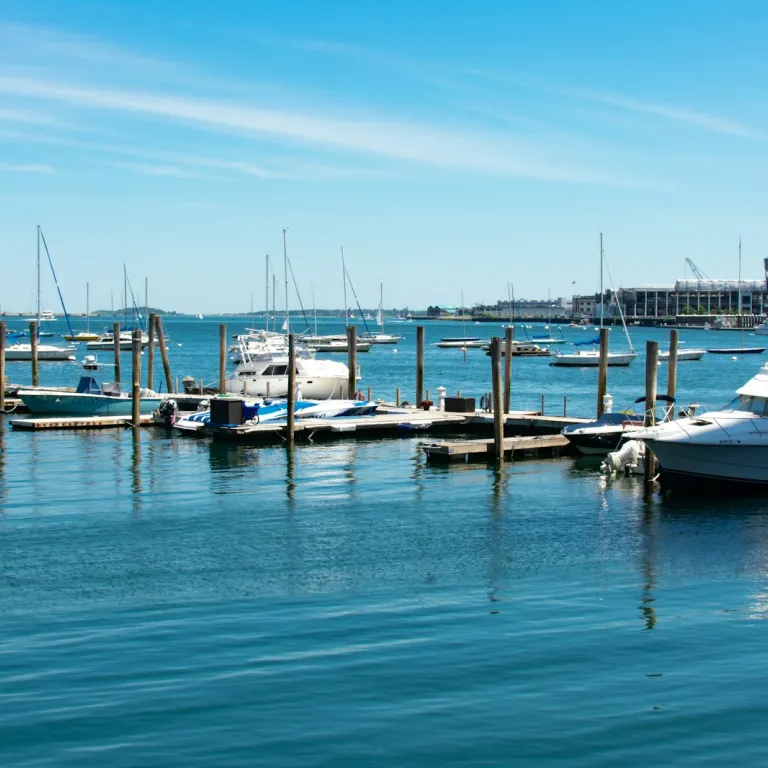
The waterfront reads wharf by wharf rather than street by street. Long Wharf is the busiest: the ferry terminal, the New England Aquarium, Christopher Columbus Park and the crowds that come with all three. Rowes Wharf, a few minutes south, is the formal one, with the archway and rotunda that frame the harbour entrance in every photograph of the skyline. Battery Wharf, at the northern end, sits against the North End and is the quietest of the three. Below them, Fort Point Channel marks the boundary with the Seaport.
Tying it together is the Harborwalk, the public path that runs along the water's edge past every one of these wharves. It is the single best argument for sleeping here: an evening walk that no other Boston neighbourhood can offer, and a direct line into the North End for dinner.
What to expect from hotels on the waterfront
The waterfront hotels are fewer than Back Bay's and more distinct from one another, because each is shaped by the pier it stands on. The Boston Harbor Hotel at Rowes Wharf is the landmark: its archway and rotunda frame the harbour entrance, and guests can arrive by water taxi or seaplane directly at the dock. The Boston Marriott Long Wharf is the stepped brick building beside the New England Aquarium and the ferry docks, which makes it the most convenient address on the harbour and the busiest.
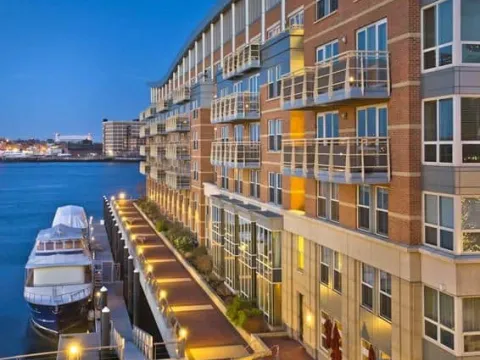
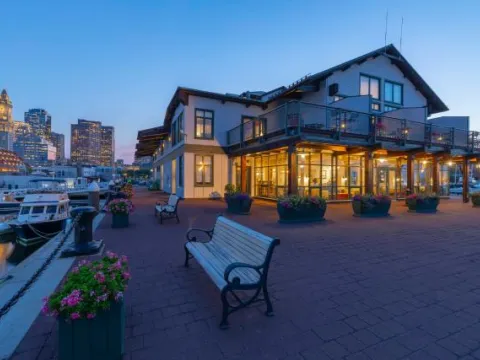
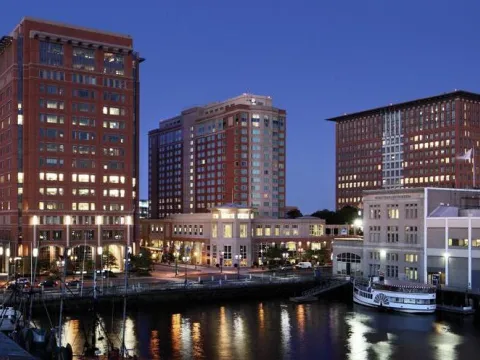
At the northern end, the Battery Wharf Hotel occupies low-rise buildings on their own pier directly on the Harborwalk, with the North End immediately behind it. To the south, the InterContinental Boston at 510 Atlantic Avenue presents a curved glass façade straight onto Fort Point Channel and the Harborwalk. A block inland, the Harborside Inn puts 200 rooms into an 1846 mercantile shipping warehouse on State Street, a block from Faneuil Hall, and is the closest thing the area has to a value option in a historic building.
Across the channel, the Seaport adds a second, newer cluster: the Envoy Hotel at 70 Sleeper Street with its Lookout rooftop, the Omni Boston Hotel at the Seaport, the Seaport Hotel Boston on Commonwealth Pier, YOTEL Boston at 65 Seaport Boulevard, and the Westin Boston Seaport District, connected by skybridge to the convention centre. It is the same water, a different neighbourhood, and worth knowing about if the classic wharves are full. Every property named here is in our list of the fifty hotels that define Boston, each one checked against its own site.
What a night on the waterfront actually costs
Harbour views are priced as views, and Boston adds its own layer on top. Our Boston Hotel Price Index follows a fixed basket: the market's average nightly rate, the 14.95 % of statutory lodging taxes the city stacks on it (5.7 % state, 6.5 % city, 2.75 % convention centre), and one 24-hour downtown garage space. That basket came to $261.76 in January 2025 and $482.24 in October 2025: an index of 184.2 against a January base of 100.
Over the year the same index shows $301.97 advertised becoming $385.11 paid, a difference of 27.5 %. On the waterfront the parking line deserves particular attention: wharf hotels are valet-heavy and garage space is finite, so it is worth pricing the car before you price the room. The Boston trip budget calculator lets you set each line yourself rather than trust an average.
One structural note that will shape the next few years here. The Boston Planning Department's Article 80 project records, compiled in our data room, show 4,038 hotel rooms delivered across the city, with 55 % of them on the South Boston waterfront. Supply is growing fastest on this side of the water, which is exactly why the newer Seaport properties are often the ones with availability when the classic wharves are not.
Location advantages: walking, ferries, and access
The waterfront is a short, flat walk from Faneuil Hall and Quincy Market, and from there the Freedom Trail runs straight through the downtown core. The North End begins directly behind Battery Wharf, which puts Boston's densest concentration of Italian restaurants within a few minutes on foot. Aquarium station on the Blue Line sits at Long Wharf, and State Street, one block inland, adds the Orange Line.
What genuinely sets this base apart is the water. Ferries from Long Wharf reach the Charlestown Navy Yard and the USS Constitution without a bus or a transfer, and the Boston Harbor Islands leave from the same dock in season. If you would rather see the days laid out before you commit to a base, our Boston itinerary builder builds them around whichever neighbourhood you choose, and the Boston neighbourhood chooser narrows the choice in seven questions.
Who the waterfront suits best, and who should look elsewhere
The waterfront suits families heading for the aquarium and the islands, cruise passengers, anyone arriving or leaving through Logan, and returning visitors who have already done the Freedom Trail and want a different Boston. It suits photographers and early risers: the harbour light in the morning is the reason people book these rooms twice.
It suits you less if you are here to shop or to eat your way along one street: Back Bay does that far better. It suits you less if you want the lowest weekday-to-weekend swing, which tends to sit in downtown Boston. And it suits you less in deep winter, when the wind coming off the harbour makes the Harborwalk a very different proposition from the one in the photographs.
How to choose the right waterfront hotel for your stay
Pick the wharf before you pick the hotel. Long Wharf for the aquarium, the ferries and the shortest walk to Faneuil Hall; Rowes Wharf for the formal harbour address and the seaplane and water-taxi dock; Battery Wharf for quiet and for the North End on your doorstep; Fort Point Channel for the crossing into the Seaport. Each is a genuinely different stay, and the distance between them is walkable but not trivial with luggage.
Then ask two questions that matter more here than anywhere else in Boston. Which way does the room face, because a harbour-view room and a city-view room in the same building are priced apart for a reason. And how does parking work, because on a pier it is valet, it is finite, and it is charged nightly.
Our other neighbourhood guides sit on the Boston where-to-stay index, autumn arrivals should read Boston in the fall first, and the rules behind these pages are set out in how we work.
Compare nearby areas: The Waterfront borders the Financial District and Downtown, both a few minutes inland, and the Seaport across the Fort Point Channel, which has the most hotel pools in Boston.
Frequently asked questions about staying on the Boston waterfront
Is the Boston waterfront a good area to stay?
Yes, particularly for families, cruise passengers and returning visitors. It puts the New England Aquarium, Christopher Columbus Park, the Harborwalk and the ferry docks within a few minutes on foot, and Faneuil Hall and the North End are both a short walk inland.
What is the difference between the waterfront and the Seaport?
They face the same harbour from opposite sides of Fort Point Channel. The waterfront is the historic run of wharves between the North End and the channel; the Seaport is the newer district built out on the South Boston side. Boston Planning Department records show 55 % of the city's 4,038 newly delivered hotel rooms went to the South Boston waterfront, which is why the Seaport often has space when the older wharves do not.
Can I reach Logan Airport easily from a waterfront hotel?
Yes. The airport sits directly across the inner harbour, reachable by the Blue Line from Aquarium station and by water shuttle from the wharves. It is the shortest airport transfer of any central Boston neighbourhood.
Is the waterfront expensive?
It is priced with the upper tier of the city, and the view carries a premium. The citywide figures matter too: Boston adds 14.95 % in statutory lodging taxes wherever you sleep, and our Boston Hotel Price Index recorded the same fixed basket rising from $261.76 in January 2025 to $482.24 in October 2025.
Which waterfront hotels are directly on the water?
The Boston Harbor Hotel stands on Rowes Wharf with its own dock, the Boston Marriott Long Wharf sits on Long Wharf beside the ferry terminal, the Battery Wharf Hotel occupies its own pier on the Harborwalk, and the InterContinental Boston faces Fort Point Channel at 510 Atlantic Avenue.
Other Boston neighbourhoods
Not sure the Waterfront is the right base for your trip? These guides cover the neighbourhoods travellers most often weigh against it.
The full Boston neighbourhood index