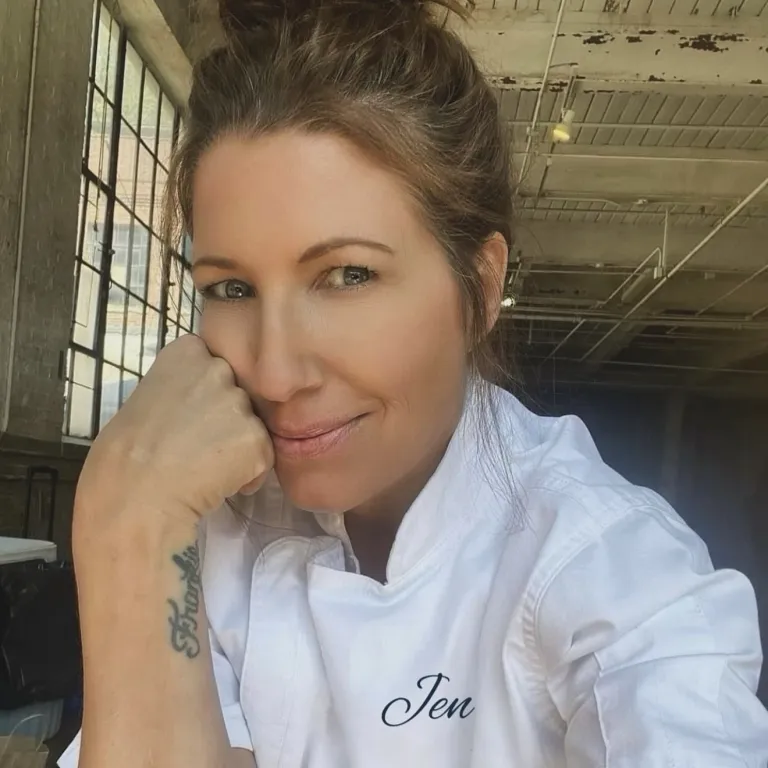
Jen, you’ve taken Italian communal dining and transplanted it into Boston’s historic North End. How did your personal journey—from private chef to opening TABLE—shape your vision of what ‘Italian gastronomic excellence’ should look and feel like in this city?
I'm probably the last person you should ask about Italian excellence in this city. There are so many chefs and restaurant owners with far more experience and talent than I have, and I still consider myself a rookie who's learning every single day what it takes to stay relevant.
My background was in catering, so my expertise has always been cooking for large groups. That's why opening an Italian restaurant with communal seating and a prix fixe menu felt like the natural choice. There were two reasons: first, no one else was really doing it, and second, I wanted to build a business around my strengths instead of setting myself up for failure.
I had zero experience running a traditional restaurant, so I knew I couldn't pretend otherwise. I leaned into what I knew, adapted as I went, and learned through experience.
And believe me, I made plenty of mistakes. But every one of them taught me something valuable. In fact, many of the things I do well today are only because I got them wrong the first time.
Your concept centers on a seven-course, family-style feast. Beyond the obvious abundance, what are the key elements—product sourcing, technique, pacing, atmosphere—that, in your mind, elevate this from simply “good Italian food” to a truly excellent Italian gastronomic experience in Boston?
The pacing of the meal is influenced by two factors: our standard two-hour-and-fifteen-minute seating on weekends and, most importantly, our guests. If we notice a table is moving through their meal more quickly, we'll try to expedite the next course without moving another party along too quickly. If guests are taking their time, the kitchen adjusts accordingly. The only time it gets dicey is when we have a double seating and time is of the essence. We understand that it's impossible to accommodate every individual preference perfectly, but we do our best to make everyone happy.
You’ve spoken about being inspired by your trips to Italy, where dishes arrive on large platters for everyone to share. Can you walk us through a specific dish or course at TABLE that most directly channels those Italian roots, and explain the thought process behind adapting it to Boston palates without losing its authenticity?
I've eaten throughout Italy, but one meal that has always stayed with me was in Sicily. We sat at a long table with about 20 people and shared enormous platters of fresh fish, pasta, and meat. It wasn't a single dish that made the experience unforgettable—it was the way everyone gathered around the food, talking, passing plates back and forth, and encouraging each other to try dishes they might never have ordered on their own. Nobody had their phones out and it was nice to go to a restaurant and be able to eat seven different things for one price. There was no chaos surrounding the check and the overall experience from start to finish was flawless.
Italian cuisine is often described as ‘simple but perfect,’ which leaves very little room for error. In the context of a fixed, communal menu, what are the biggest technical and operational challenges you face in maintaining a consistently high level—from homemade pasta to seafood and your award-winning meatballs—night after night?
The biggest challenge is creating a menu that appeals to all 32 guests. I'd love to offer an even more diverse selection, but today's wide range of dietary restrictions makes that difficult. For example, I can't build a pasta dish around crab because of seafood allergies, and I also have to consider guests who require gluten-free options. I'd love to incorporate more pancetta into our dishes, but many people don't eat pork, for example. For some reason, we have an unusually high number of guests with seafood allergies. We also have many guests who don't eat meat, and when those dietary restrictions are combined with gluten-free needs, the available menu options become extremely limited.
Our kitchen is small and refrigeration space is limited, so while we do our best to accommodate as many preferences as possible, it's simply not feasible to cater to every individual dietary need without compromising the overall menu.
Boston now has a crowded Italian dining scene, especially in the North End. From your vantage point, what really distinguishes the best Italian kitchens here—from ingredient choices and regional inspirations to service style—and where do you feel TABLE fits into that hierarchy of excellence?
I can't speak for other restaurants—I can only speak for ours and the experiences we've shared with our guests over the past seven years.
On many occasions, our guests have hugged our staff at the end of the night, thanking them for creating a memorable experience. We have a large corkboard covered with handwritten letters and notes on the backs of receipts from guests who took the time to express their gratitude. Those messages mean everything to us.
We host countless rehearsal dinners, wedding celebrations, birthdays, corporate dinners, and full private buyouts. Our space was built for these moments, and we genuinely love being part of life's biggest celebrations.
Dining out isn't inexpensive, and if you've chosen us to celebrate your anniversary, birthday, or another special occasion, we believe we have a responsibility to make that experience memorable.
For readers who dream of experiencing or even creating this level of Italian excellence at home or in their own ventures, what concrete advice would you share—whether it’s about ingredients, technique, mindset, or the spirit of hospitality that, to you, defines great Italian food in Boston?
My advice is simple: stay in your lane. Don't try to be anyone else, and don't waste your energy trying to do better than your neighbor. Focus on what you're capable of and try to do it exceptionally well.
I know what I do well, and I don't try to be everything to everyone. I also don't let anyone call me "Boss" or "Chef." I'm Jen. I stay humble if not self-depricating at times which leads me to often being pleasantly surprised.
My staff isn't just my staff—they're my family, and we're a team. If they're in the trenches, I'm in the trenches. If they're working a holiday, I'm working a holiday. I would never ask them to do something I wouldn't do myself.
Some days the stress has me crying in the stairwell. Other days I can't stop laughing with my team. That's the reality of this business. It's exhausting, unpredictable, and incredibly rewarding all at once.
If you're not ready for the scariest, greatest roller coaster ride of your life, this probably isn't the business for you. But if you are, there's nothing else quite like it.
Learn more: https://tableboston.com