Boston is a small city that behaves like a large one. You can walk from the Public Garden to the harbour in twenty-five minutes, and yet the room you book on one side of that walk will give you a completely different week from the room you book on the other. Choosing a hotel here is really choosing a neighbourhood, and choosing a neighbourhood is choosing what your mornings look like.
This guide is the written form of what we spend our time on at Stay In Boston: reading the city block by block, checking what each hotel actually is rather than what its own website says it is, and following what a night in this city genuinely costs once the taxes and the parking are added. It is organised the way a trip is organised, where to sleep first, then what it costs, then when to come, then what to do with the days you have. Every figure in it comes from work we have already published and sourced on the site, and every link takes you to the longer version.
Five parts, 111 verified addresses, three walking routes and thirteen maps drawn on real Boston geography. It opens in the browser, needs nothing installed, and every figure in it comes from work already published and sourced on this site.
Download the guide here
What is in the 2026 edition
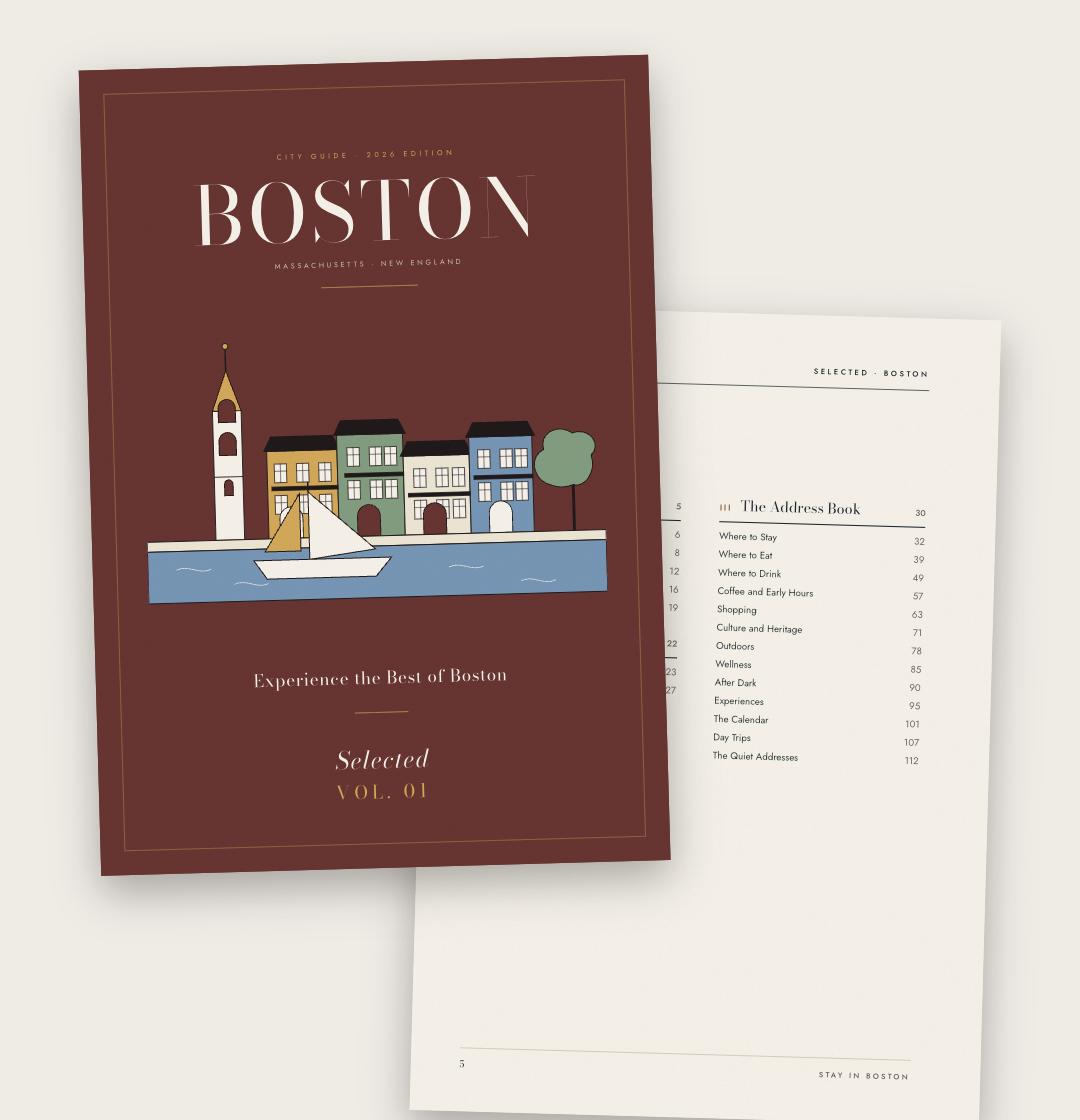
The guide is organised the way a trip is organised, in five parts.
- Opening. The spirit of the place, Boston in ten facts, when to go, getting there and around, and the local codes nobody tells you about.
- The Territory. The six neighbourhoods that carry the decision, and three walking routes that hold together from morning to dinner.
- The Address Book. 111 entries, each with one detail worth knowing, the reason it is in the book, and a practical line: where to stay, where to eat, where to drink, coffee and early hours, shopping, culture and heritage, outdoors, wellness, after dark, experiences, the calendar, day trips and the quiet addresses.
- Themes. Style, the art scene, the food scene, nightlife, architecture and design, makers and craft, travelling with children, travelling better.
- Practical. What you need on the ground, and the full address book in one index.
Thirteen plates redraw the same base map of Boston. The coastline, the Charles, the parks and the axes never move; only the addresses lit in gold and the neighbourhood in relief change from chapter to chapter, so you can read one chapter on its own and still know where you are standing. A longer walk through the edition is in our note on what is inside the guide.
Where to stay: the seven areas that matter
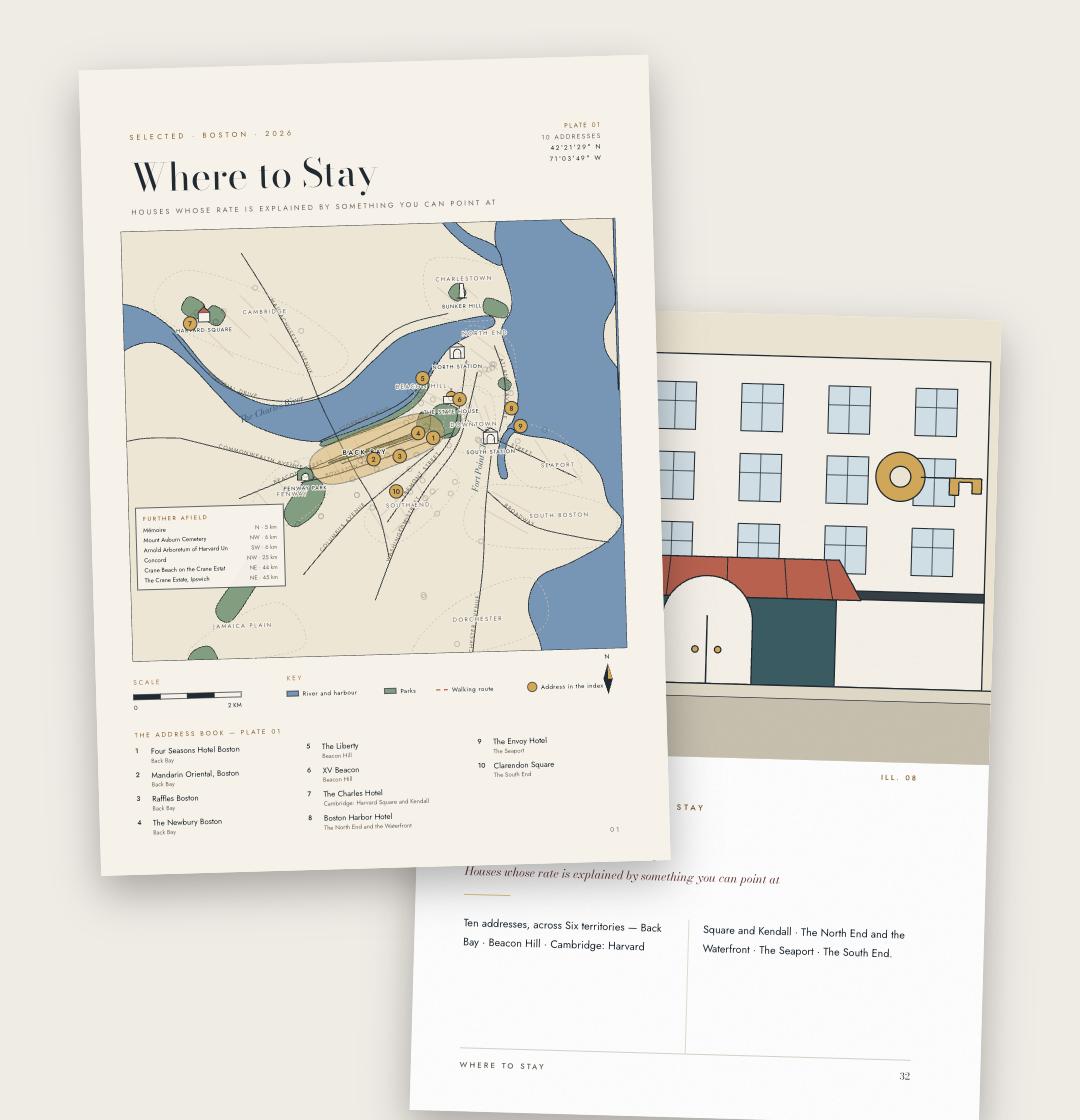
In the guide itself, ten hotel addresses are mapped across six territories: Back Bay, Beacon Hill, Cambridge around Harvard Square and Kendall, the North End and the Waterfront, the Seaport and the South End. Downtown, the seventh area below, is where most first visits start, so it is worth reading alongside them.
Boston has dozens of named neighbourhoods. For a visitor deciding where to sleep, seven of them carry almost all of the decision. Below is what each one is for, and the hotels we have verified in each. Every property named here appears in one of our neighbourhood guides, where you will find room detail, access notes and reservation links.
Downtown Boston, for the first visit
Best for: first-time visitors, walkers, anyone who wants the Freedom Trail and the harbour on the same day.
Downtown is the historic core, and it is the one area where you can leave the hotel without a plan and still have a good day. It is also the densest cluster of grand hotels in the city, which means the widest range of rates: the same street can offer a landmark suite and a well-run mid-range room. The trade-off is noise and construction, and the fact that some blocks empty out after office hours.
Hotels we have verified here: The Langham, Boston; Four Seasons Hotel Boston; The Ritz-Carlton, Boston; Boston Harbor Hotel; XV Beacon; Omni Parker House; The Godfrey Hotel Boston; Canopy by Hilton Boston Downtown. Read the full comparison in our Downtown Boston hotel guide.
Back Bay, for shopping, dining and Victorian streets
Best for: couples, repeat visitors, anyone who wants restaurants and shops on the doorstep.
Back Bay is the most consistently pleasant place to walk in Boston: flat, ordered, lined with brownstones, with Newbury Street running through it. It is also the neighbourhood where the gap between a good hotel and a great one is most visible, because several of the city's best properties sit within a few hundred metres of each other.
Hotels we have verified here: Mandarin Oriental, Boston; The Newbury Boston; Fairmont Copley Plaza; The Eliot Hotel; The Colonnade Hotel; The Lenox Hotel. The detail is in our Back Bay hotel guide.
The Waterfront and Seaport, for water views and new build
Best for: conference visitors, families who want space, travellers arriving late from Logan.
This is the part of Boston that has changed most, and it is where most of the city's new rooms have landed. Our Data Room analysis of Article 80 development filings found 4,038 hotel rooms delivered through those projects, with 55 percent of them on the South Boston waterfront. The rooms are newer and larger than in the historic core; the streets are quieter in the evening.
Hotels we have verified here: Boston Harbor Hotel; InterContinental Boston; Omni Boston Hotel at the Seaport; The Westin Boston Seaport District; YOTEL Boston. See our Waterfront and Seaport hotel guide.
Beacon Hill, for quiet and character
Best for: returning visitors, slow mornings, anyone who values calm over convenience.
Beacon Hill is residential, and that is the point. Gas lamps, brick pavements, very few chain signs. It has the smallest hotel supply of the central neighbourhoods, which makes availability tight in peak months, and the streets are steep enough to matter if you are carrying luggage.
Hotels we have verified here: The Whitney Hotel; The Liberty Hotel; Beacon Hill Hotel and Bistro; XV Beacon; Wyndham Boston Beacon Hill. Full notes in our Beacon Hill hotel guide.
The Theater District, for evenings out
Best for: theatre and concert nights, groups, travellers who want to walk home after dinner.
The Theater District sits between Boston Common and the South End, and it is the most useful base if your evenings are booked. It also holds the widest price range of any central area, from a landmark suite to a compact modern room, within the same few blocks.
Hotels we have verified here: The Ritz-Carlton, Boston; W Boston; Revere Hotel Boston Common; Hilton Boston Park Plaza; Moxy Boston Downtown; Found Hotel Boston Common. See our Theater District hotel guide.
Dorchester, for value and a real neighbourhood
Best for: longer stays, drivers, travellers who want the city without the centre's rates.
Dorchester is the largest neighbourhood in Boston and the one most visitors never consider. Rooms cost meaningfully less than downtown, parking is easier, and the Red Line puts the centre within reach. What you give up is walkability to the sights.
Hotels we have verified here: DoubleTree by Hilton Hotel Boston Bayside; Ramada by Wyndham Boston; Comfort Inn Boston; Boston Lodge and Suites. See our Dorchester hotel guide.
Allston and Brighton, for students, hospitals and long stays
Best for: visits tied to a university or the Longwood medical area, extended stays, tight budgets.
Allston and Brighton are young, cheap by Boston standards, and well connected to Cambridge and the Longwood Medical Area. This is where suite hotels and inns make sense, and where a week costs what three nights cost downtown.
Hotels we have verified here: Studio Allston Hotel; DoubleTree Suites by Hilton Hotel Boston - Cambridge; The Atlas Hotel; Homewood Suites by Hilton Boston Brookline-Longwood Medical; The Farrington Inn. See our Allston and Brighton hotel guide.
If you would rather answer a few questions than read seven guides, our where to stay in Boston tool scores the neighbourhoods against your dates, budget and priorities and gives you a first choice, an alternative and a budget option.
What a night in Boston really costs
The rate you see quoted is not the rate you pay. Boston stacks three separate lodging taxes on every hotel night: 5.7 percent state, 6.5 percent city, and 2.75 percent for the convention centre, which comes to 14.95 percent before anything else is added. Add a night of central parking and the gap between the advertised figure and the figure on your card becomes the single largest surprise in a Boston trip budget.
We track this month by month in the Boston Hotel Price Index, a fixed basket rebased to 100 in January. The three numbers worth carrying with you:
Month | Basket total per night | Index (January = 100) |
|---|---|---|
January, the cheapest month | 261.76 dollars | 100.0 |
October, the peak | 482.24 dollars | 184.2 |
December | 285.48 dollars | 109.1 |
Across the year, an average advertised rate of 301.97 dollars became 385.11 dollars actually paid, a gap of 27.5 percent. The swing between the cheapest and the most expensive night is 220.48 dollars. Moving your trip by a few weeks is, in Boston, worth more than any loyalty programme.
Two practical consequences. First, compare total costs rather than nightly rates, since the tax is proportional and the parking is not. Second, check what the hotel charges for parking before you book a car: it is often the difference between two properties that looked identical. If you want the arithmetic done for you, the Boston trip budget calculator breaks a stay down line by line and lets you set every figure yourself.
When to go
Boston does not have a high season and a low season so much as a steep curve. Our Data Room analysis of market occupancy found hotels running at 87.8 percent in October against 54.3 percent in January. That single fact explains most of what you will experience: availability, price, queue length at the popular sites, and how far in advance you need to book.
What drives the peaks is not only tourism. Boston fills up on conferences, on university calendars and on events. Meet Boston reported 292,000 group room nights in a year, Logan Airport handled 43.2 million passengers, and the city holds 152,493 students across its institutions. Move-in weekends, graduation weekends and marathon weekend behave like public holidays for the hotel market.
The practical read, by season:
September to early November. The best weather and the worst prices. Book two to three months out, or accept the October index of 184.2.
December. Cold, festive, and far cheaper than autumn. The index falls back to 109.1.
January to March. The value window. Fewer visitors, real winter, and the widest choice of rooms in the best hotels.
April to June. Improving weather, but marathon weekend and graduation weekends spike sharply. Check the dates before you fix yours.
July and August. Warm, humid, busy with leisure travellers, and pleasant on the waterfront.
For the autumn specifically, which is both the best and the most expensive time to come, we have written a separate seasonal guide: Boston in the fall.
Three itineraries
Twenty-four hours
Start on the Freedom Trail at Boston Common and walk it as far as Faneuil Hall, which takes a morning at an unhurried pace and covers most of what people come to see. Lunch in the North End. Cross to the waterfront in the afternoon and walk the Harborwalk. Finish with dinner in Back Bay or the Theater District, both walkable from the centre. If you only have one night, sleep downtown: it removes every transfer from this plan.
Three days
Day one as above. Day two belongs to the museums and to Back Bay, with the Public Library, Newbury Street and the Fenway institutions filling an afternoon comfortably. Day three is either Cambridge, one stop across the river and a genuinely different city, or the harbour islands in summer. Three days is the point at which a Back Bay or Beacon Hill base starts to make more sense than downtown, because you will spend your evenings where you sleep.
A week
With a week, add the neighbourhoods that day-trippers never reach: Dorchester and its waterfront, Jamaica Plain, the South End for its restaurants, and a day trip north to Salem or south to the Cape. A week is also when the cost arithmetic changes, an Allston, Brighton or Dorchester base for part of the stay can pay for a better hotel for the rest of it. Our Boston itinerary builder will lay this out day by day against your own pace and interests.
Where to eat and drink
Boston's restaurant scene is neighbourhood-shaped in the same way its hotels are. The North End is Italian and always will be; the South End is where the ambitious kitchens are; the Seaport is new money and big rooms; Back Bay is where you eat well without planning ahead. Hotel dining in this city is unusually strong, several of the best rooms in Boston are inside hotels rather than around the corner from them.
Rather than repeat a list here, we keep a verified one: the 50 places to eat and drink in and around Boston hotels, checked against each establishment's own site, with closures removed.
Practical information
From the airport. Logan is unusually close to the centre, which is one of the quiet pleasures of visiting Boston. The Silver Line runs from the terminals to South Station and is free inbound; a taxi to downtown is short outside rush hour.
Getting around. The MBTA, universally called the T, covers everything a visitor needs. Boston is also the rare American city where walking is usually faster than driving for central distances.
Driving and parking. Do not rent a car for a city-only stay. Central hotel parking is expensive, priced per night, and rarely included, and street parking is scarce.
Fees and disclosure. Since 12 May 2025, the Federal Trade Commission rule at 16 CFR 464 requires the total price, including mandatory fees, to be shown up front. If a resort fee or destination fee appears only at checkout, that is now worth querying.
Weather. Plan for four real seasons. Winter is genuinely cold and occasionally disruptive; autumn is mild and bright; summer is humid, and the waterfront is several degrees more comfortable than the centre.
Booking window. For September and October, two to three months. For January to March, a few weeks is usually enough. Around marathon, graduation and large conventions, as early as you possibly can.
Frequently asked questions
Which neighbourhood should I pick for a first visit to Boston?
Downtown, for one simple reason: it removes transfers. The Freedom Trail, Faneuil Hall, the Common and the harbour are all within walking distance, and the hotel supply is wide enough to find a room at most price points. Back Bay is the better second choice if you would rather have restaurants and shops on the doorstep.
What is the cheapest month to stay in Boston?
January. Our Price Index basket costs 261.76 dollars a night in January against 482.24 dollars in October, a difference of 220.48 dollars per night for the same basket. February and March remain close to the January level.
How much tax is added to a Boston hotel bill?
14.95 percent in the city of Boston: 5.7 percent state, 6.5 percent city and 2.75 percent for the convention centre. Parking, resort fees and destination fees sit on top of that and are not proportional, which is why two hotels with the same rate can produce very different bills.
Do I need a car in Boston?
For a city stay, no, and it will cost you money and patience. The T covers the visitor map, and central distances are walkable. A car only earns its keep if you are basing yourself outside the centre or taking day trips.
Where should I stay for a week rather than a weekend?
Consider splitting. Beacon Hill or Back Bay for the part of the trip you want to remember, and Allston, Brighton or Dorchester for the rest, where rooms cost meaningfully less and suite hotels are common. A week in the centre at autumn rates is one of the more expensive weeks in the United States.
How far in advance should I book?
Two to three months for September and October, when occupancy runs near 88 percent. A few weeks is usually enough between January and March, when it falls to around 54 percent. Marathon weekend, graduation weekends and large conventions are exceptions in every month.
The quiet addresses
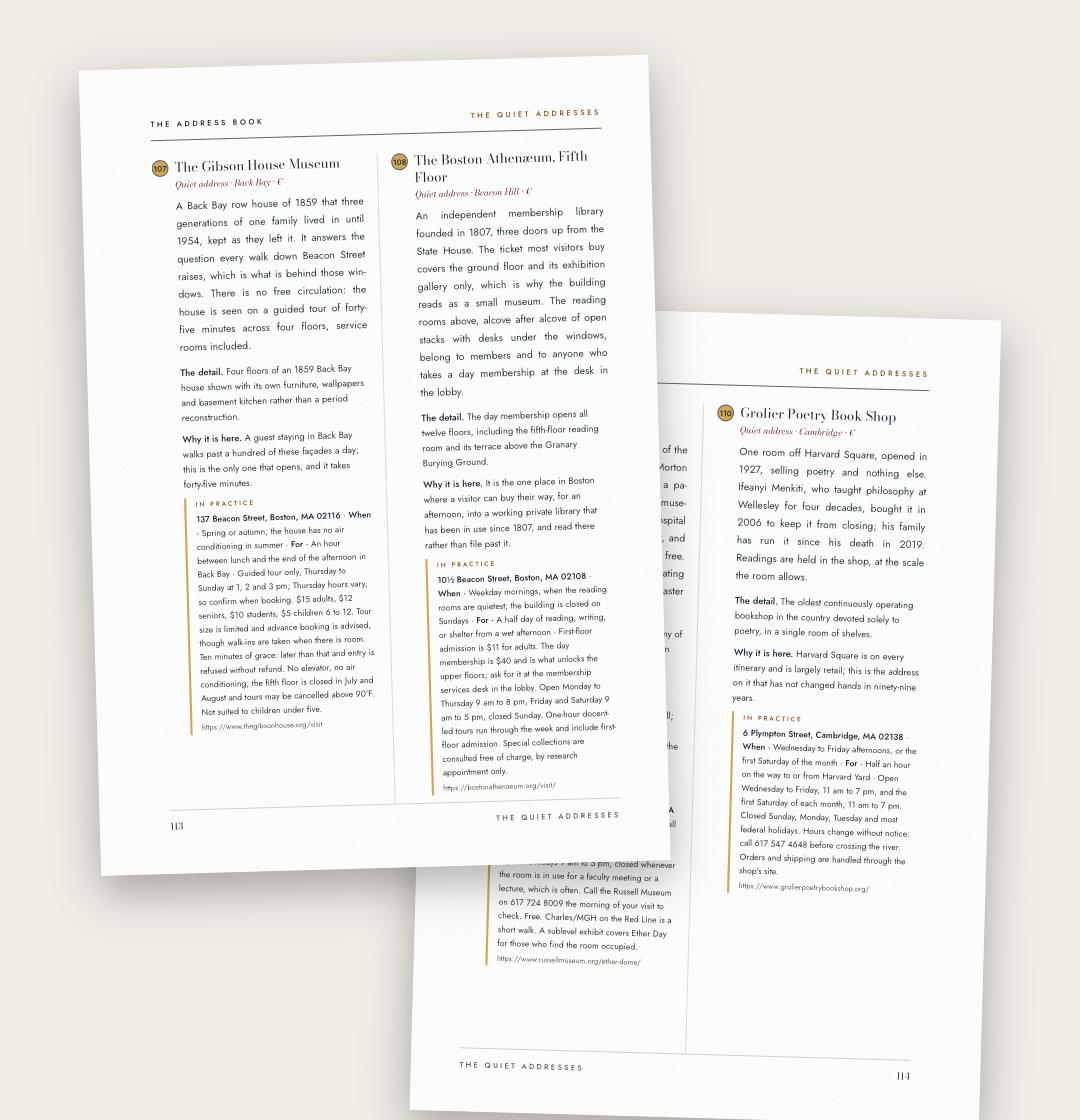
The address book closes on five places that cost almost nothing, take under an hour, and are usually what people remember. Among them: an 1859 Back Bay row house kept exactly as one family left it in 1954, the fifth floor of the Boston Athenaeum which a day membership opens, the Ether Dome, free and twenty minutes from Beacon Hill, and a one room poetry bookshop off Harvard Square open since 1927.
How this guide is made
Every hotel named in this guide appears in one of our neighbourhood guides, where it was checked against the property's own site before publication; establishments that had closed or announced closure were removed. Every figure comes from work already published on this site with its sources named and dated: the price and tax figures from the Boston Hotel Price Index, the occupancy, development and visitor figures from the Data Room. Where public data does not exist, we say so rather than estimate.
We do not claim to have slept in every hotel we write about, and we say so plainly in our methodology. What we do is read the city closely, verify what can be verified, and tell you what we would want to know before booking. If you spot something out of date, we would rather hear it than not.
This guide is updated as the city changes. Join the Stay In Boston club and we will tell you when a new edition is out, along with what we have found in the meantime.