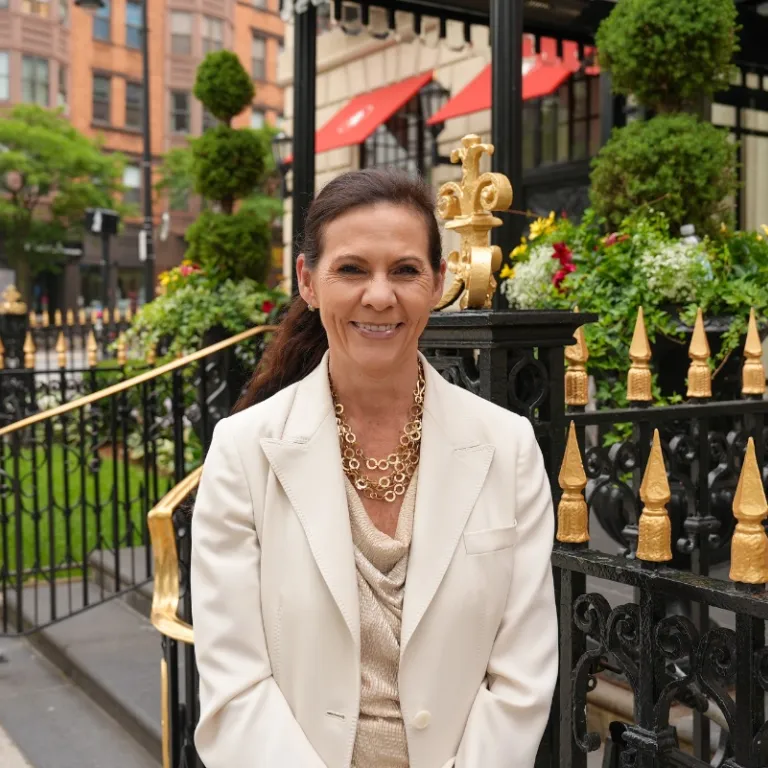
Pascale, you’ve been leading The Eliot Hotel for more than 25 years. How would you introduce the hotel and your own role in shaping its identity as a benchmark for boutique luxury in Boston’s Back Bay?
Honestly, I still feel excited walking into this lobby every morning, even after 30 years. That tells you something. The Eliot has always been a hotel that resists the idea that luxury must be loud. From the beginning, the philosophy has been that true hospitality is felt more than it's seen: in the quality of the furnishings, the way a request is anticipated before it's made, the calm of the lobby versus the energy of the street outside.
My focus from day one was building a culture, not just a service standard, because standards can be copied, but culture has to be lived by every person on staff, every day. Thirty years in, what I'm proudest of is that the team here understands intuitively what "Eliot hospitality" means and can improvise inside that philosophy rather than following a script. It's a bit like family. I know that word gets used loosely in hospitality, but it's true. People stay. They grow here. And that continuity is what guests feel the moment they walk in.
The Eliot occupies a nearly 100-year-old Georgian neo-classical building in a historic neighborhood. How do you translate that architectural and cultural heritage into a very contemporary experience of luxury and excellence for today’s guests?
This building is one of the most beautiful things about my job. It's such a cornerstone of this neighborhood, and I never take that for granted. I work with ownership daily on it. It's a genuine priority for all of us to keep improving and caring for this beautiful building, not just maintain it. The proportions, the exterior, the sense of permanence you get walking in off Commonwealth Avenue: my job is to make sure everything layered on top of that heritage feels considered. That means restoring original architectural details while completely modernizing the infrastructure behind the walls, HVAC, connectivity, soundproofing, things guests never see but absolutely feel.
Contemporary luxury, to me, isn't about stripping away history to look modern. It's about making a guest today feel the building was made for them: fast, reliable technology, a design language that respects the architecture but doesn't feel like a museum, service that's warm rather than formal. The heritage gives us gravitas. The care we put into this building every single day is what makes it feel alive.
You are often credited with elevating The Eliot into the luxury segment through both visible amenities and behind-the-scenes operational systems. Can you walk us through a few specific decisions or initiatives that, in your view, most clearly define this step up in excellence?
Deciding, early on, that we were competing with the best hotels in the world, not just the best hotels in Boston. That shift in mindset changed everything. It meant our standards for service, for training, for how we recognized and remembered guests, had to match what you'd find at the most celebrated properties anywhere, not just what was expected locally.
Building a culture of genuine, personal recognition. It's about a guest feeling truly known. We invested heavily in making sure our team remembers preferences, anticipates needs, and treats every returning guest like they've been away rather than like a new reservation.
Boston is full of high-end hotels, from large chains to newer lifestyle concepts. In concrete terms, what does a guest experience at The Eliot—its service style, ambiance, suite design, or restaurant partnership—offer that a larger luxury property in the city simply cannot replicate?
Scale is the honest answer, ours and theirs. A large luxury property, however well run, is built around consistency across hundreds of rooms and often multiple properties. We're built around 95 guest rooms and suites, which means the general manager, me, can still know a meaningful share of our regular guests by name, and staff can adjust in real time rather than escalating through layers of management.
Concretely: from the moment you step out of the car, you're greeted with a level of hospitality that immediately sets the tone for the entire stay. That first impression is everything, and we treat it that way. And once you're inside, the building itself tells its own story. This building was actually designed by Harvard President Charles Eliot for retired Harvard professors. Originally, each of the suites was an apartment, with a bedroom and a living room separated by French doors. Today, that same DNA has evolved into something even more remarkable: a true suite, with a distinct bedroom, a separate living area, a dedicated workspace, and a wet bar. Real, defined spaces, not a single room with furniture pushed around to suggest zones. We're a smaller hotel by design, but our suites are genuinely spacious, more square footage than you'll find in rooms at properties many times our size. That history is still very much alive in how these suites feel today: a real sense of a Back Bay pied-à-terre, comfortable, layered, effortlessly elegant, but unmistakably luxurious.
Excellence in a small independent boutique hotel can be fragile, especially with rising costs, staffing challenges, and ever-higher guest expectations. What are the toughest operational or strategic challenges you face in maintaining this very high standard, and how do you address them on a daily basis?
Honestly, we're doing very well. I don't want to overstate the challenges, because this hotel is in a strong position. If I had to point to something that keeps me thinking, it's staying on top of the ever-growing pace of technology: AI, guest expectations shaped by it, the systems behind the scenes that need to keep evolving. It's less about any one challenge and more about making sure we never get comfortable, that we keep asking what's next, even when things are going well.
Looking ahead to the next decade, including after The Eliot’s centennial, how do you imagine luxury boutique hospitality evolving in a city like Boston, and what are the key investments or cultural shifts you believe are necessary to keep The Eliot at the forefront of that evolution?
I think the next decade is going to be defined by a real tension between technology and human connection, and I want us to be on the right side of that. So much of hospitality now is about efficiency: check-in from your phone, requests through an app, everything streamlined. And for some guests, that's genuinely what they want, and we should absolutely use technology to our advantage, to be more efficient, more proactive rather than reactive, anticipating a guest's needs before they even have to ask.
But I also think something gets lost when efficiency becomes the whole story. Feeling truly seen, feeling taken care of by another person who's paying attention to you specifically, that's becoming almost a lost art. And that's exactly where I think a hotel like The Eliot has to stay rooted. At our core, we are about personalized service.
So the investment I care most about isn't really a renovation or a piece of technology. It's making sure we use tech in the background to free our team up to do more of that human work, not less. Technology should remove friction so our people can spend their energy on connection, not replace the connection altogether. A small example, but one I think about a lot: right now, if we know a guest is celebrating a birthday or anniversary, I'd like to build that into something more distinctive and personal, something like a small custom dessert from our chef with the guest's name written on the plate, a handwritten note from me or a senior member of the team, made for that guest, that moment, not pulled from a standard package. That's the kind of investment I think matters most for the next decade: not bigger, just more genuinely personal.
For travelers who may only know Boston through big-brand hotels, what personal advice or message would you share about choosing—and fully appreciating—the experience of staying in an independent luxury boutique property like The Eliot?
Ask yourself what you actually want from a hotel stay. If it's absolute predictability, knowing exactly what your room will look like before you arrive because you've stayed at the same brand in six other cities, a large chain will serve you well.
But if you want to feel like you're staying somewhere, in a real neighborhood, with a team that can tell you where locals actually eat and can adjust to what you specifically need rather than what's in a brand standard, that's where an independent property earns its keep. My advice is simple: talk to the staff, ask questions. The difference reveals itself immediately in how a hotel responds to you as an individual rather than as a reservation.
Learn more: https://www.eliothotel.com/