Why choose Boston’s South End for your stay
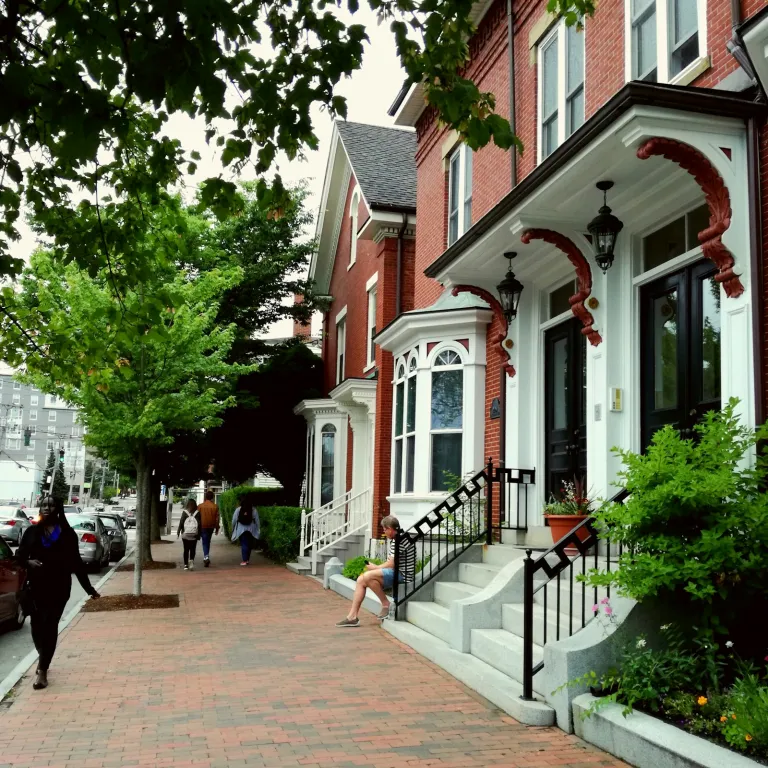
Tree-lined streets, cast-iron railings, and rows of brick bow-front townhouses set the tone in Boston’s South End. This is not downtown Boston’s glass-and-steel skyline; it is a residential grid where you step out of your hotel and immediately feel part of the city’s daily rhythm. For many guests, that mix of neighborhood calm and central access is precisely why a hotel in Boston South End becomes the smartest choice.
From a practical standpoint, the South End starts just south of Back Bay station, a few minutes’ walk away, which keeps you close to the center of Boston without being in the thick of the tourist crowds. You can reach Boston downtown, the Theater District, and the Financial District quickly, yet return to quieter streets for the night. For travelers comparing different Boston hotels, this balance of access and atmosphere often matters more than a marginally shorter taxi ride.
The area suits guests who value character over spectacle. You will not find sprawling resort-style properties here; instead, you get intimate accommodation, often in converted townhouses or low-rise buildings, with a stronger sense of place than many hotels south of the Fort Point Channel or in South Boston. If your ideal stay involves walking to dinner on Tremont Street, browsing galleries on Harrison Avenue, and then returning to a refined, low-key hotel, the South End is a very good fit.
South End hotels on one map
For a neighborhood this well known, the South End has surprisingly few places to stay: its Victorian streets are almost entirely homes, restaurants and galleries. We picked six, from boutique hotels by Back Bay station to suite hotels on the southern edge, and measured the walk from each to Back Bay station and to the SoWa Open Market on the street network. Two of them sit on the southern border with Roxbury rather than in the historic South End, and we say so below.
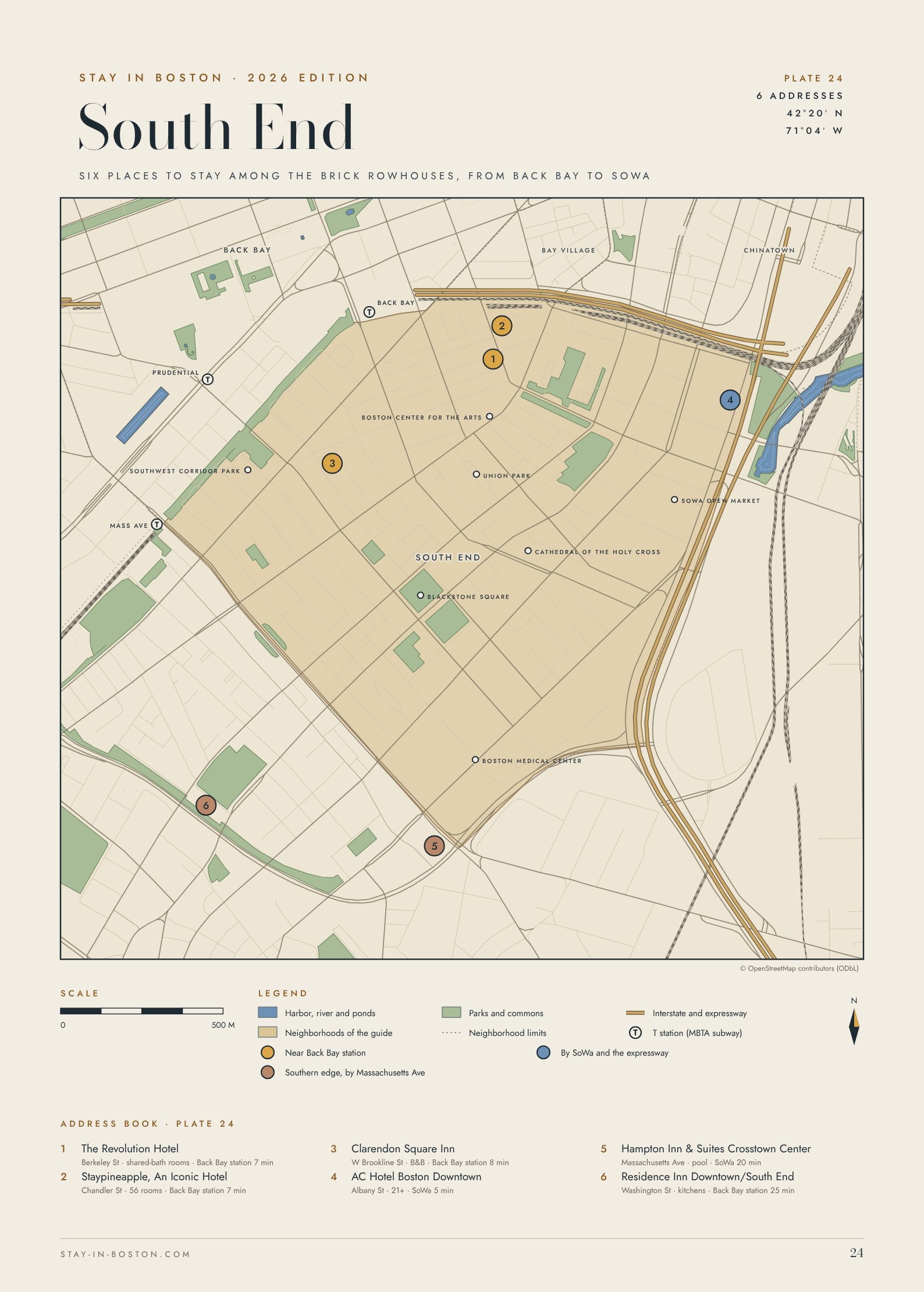
Tap the map to open it full size. Gold pins are near Back Bay station, the blue pin by SoWa and the expressway, terracotta pins on the South End and Roxbury border, along Massachusetts Avenue and Melnea Cass Boulevard.
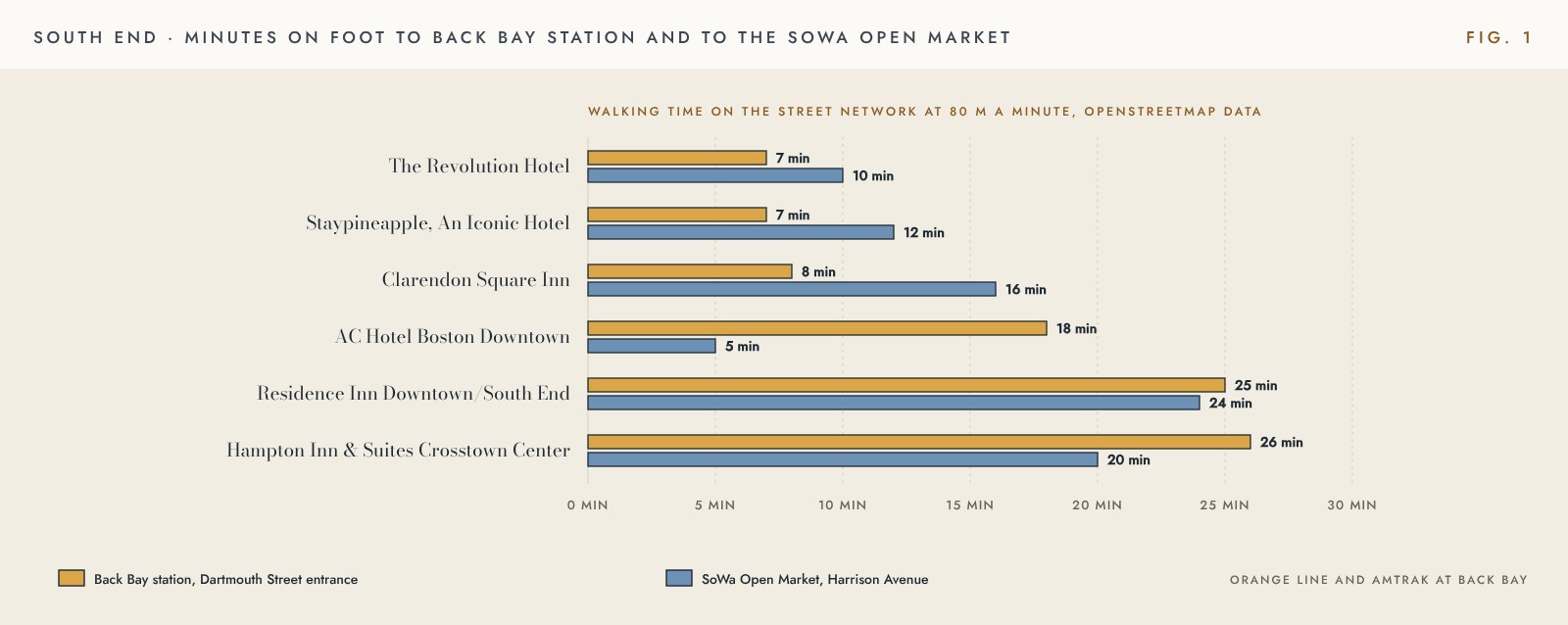
The chart shows two different South Ends. The Revolution, Staypineapple and the Clarendon Square Inn are 7 or 8 minutes from Back Bay station, with Copley Square and Newbury Street a little further on. The AC Hotel, on Albany Street, is 5 minutes from SoWa but 18 from Back Bay. The Residence Inn and the Hampton Inn, on the southern edge, are 20 to 26 minutes' walk from both, so plan on the Silver Line buses along Washington Street (the SL4 runs to South Station, the SL5 to Downtown Crossing) or on the Orange Line: Ruggles is about 11 minutes from the Residence Inn, and Massachusetts Avenue station about 17 minutes from the Hampton Inn.
South End hotels at a glance: style, parking and nightly fees
Figures come from the hotels' own pages where they publish them, and otherwise from travel-site listings, marked with an asterisk. "Not confirmed" means we found no published figure either way; check the booking breakdown before you pay.
| Place to stay | To Back Bay station | Style | Parking a night | Mandatory fee a night | Pets |
|---|---|---|---|---|---|
| The Revolution Hotel | 7 min | Design hotel, some shared-bath rooms | None on site | None (hotel FAQ) | Dogs, $25 a stay |
| Staypineapple, An Iconic Hotel | 7 min | Boutique, 56 rooms | None on site | $24.95 amenity fee | Dogs, $29.95 a night |
| Clarendon Square Inn | 8 min | B&B in an 1860s townhouse | Nearby garages, about $39 | No nightly fee identified; $45 non-refundable direct-booking fee | No pets |
| AC Hotel Boston Downtown | 18 min | Modern, 205 rooms, minimum check-in age 21 | Valet $62 | $29.12* | $100 a stay |
| Residence Inn Downtown/South End | 25 min | Suites with kitchens, breakfast, minimum check-in age 21 | Valet $55 | Not confirmed | $100 a stay |
| Hampton Inn & Suites Crosstown Center | 26 min | Indoor pool, breakfast | Self $30 | Not confirmed | $75 to $125, by length of stay |
Checked October 19, 2026, on the hotels' official pages first. An asterisk marks a figure from a travel-site listing. Walking times are rounded estimates on OpenStreetMap's street network at 80 meters a minute, to the Dartmouth Street entrance of Back Bay station and to the SoWa Open Market at 500 Harrison Avenue.
Which South End hotel should you choose?
- For the neighborhood itself: The Revolution Hotel, on Berkeley Street, has a large mural by Tristan Eaton in the lobby and "Bath Down the Hall" rooms of 115 to 150 square feet that share single-occupancy restrooms, a cheaper way into the area. Staypineapple, on Chandler Street, has 56 rooms a few steps away. Neither has parking on site.
- For a bed and breakfast: the Clarendon Square Inn occupies an 1860s townhouse on West Brookline Street, close to Union Park and the Tremont Street restaurants, with a rooftop hot tub. Breakfast is a selection of snacks and coffee in the room rather than a cooked meal, and pets are not accepted.
- For SoWa, the galleries and a quick hop downtown: the AC Hotel Boston Downtown, opened in 2018 on Albany Street, is the closest to SoWa and to Chinatown. The minimum check-in age is 21, according to Marriott.
- For families, long stays or a car: the Residence Inn has kitchens and free breakfast, and the Hampton Inn & Suites Crosstown Center has an indoor pool, free breakfast and self-parking at about $30, far less than central Boston. Both are on the border with Roxbury, where Marriott places the Residence Inn, and the Residence Inn also sets a minimum check-in age of 21.
If you would rather be within a short walk of everything, our Back Bay hotel guide covers the hotels just north of Back Bay station.
Atmosphere, streets, and daily life around your hotel
Morning in the South End starts with dog walkers on Shawmut Avenue and the smell of coffee drifting from corner cafés. Staying here means you are likely to join that flow, not just observe it from a taxi window. Guests who choose a hotel south of the Back Bay skyline often comment that they feel less like visitors and more like temporary residents of the city.
On a short walk from your accommodation to the Southwest Corridor Park, you pass pocket gardens, small playgrounds, and basketball courts tucked between brick buildings. This linear park, running roughly parallel to Columbus Avenue, becomes your informal jogging track or a place to sit with a takeaway breakfast. It is a different experience from staying in Boston downtown, where green space is more formal and often busier.
Evenings shift the mood. Tremont Street, sometimes called “Restaurant Row”, fills with diners heading to bistros, wine bars, and inventive kitchens that draw people from across the United States, not just from nearby neighborhoods. Choosing a South End hotel means you can walk to dinner and back in minutes, without negotiating taxis or the subway. For many, that walkable, restaurant-rich environment is a decisive factor when they check availability and compare Boston hotels.
Types of hotels you will find in the South End
Accommodation in the South End tends to be compact, design-conscious, and urban. You will see fewer large chains than in Boston downtown, and more independent properties or smaller city hotels that occupy existing buildings. Some are housed in former residences, others in mid-century structures that have been carefully reworked. The result is a set of hotels that feel rooted in the neighborhood rather than parachuted in from a generic template.
Room categories usually range from efficient queen rooms to more generous king rooms or suites, sometimes with city views over brick rooftops toward the center of Boston. If you are used to the scale of a highway-side inn elsewhere in the United States, expect a tighter footprint here but often better finishes and a stronger sense of style. When you compare options, pay attention to the exact room size in square metres, not just the star rating, as layouts can vary significantly between properties.
Travelers who prefer familiar brands will still find a few recognizable names on the edges of the South End, especially closer to Back Bay and near major medical centers. These can be useful if you collect loyalty points or want a predictable experience similar to a residence inn style of stay. Others will gravitate toward more individual hotels south of Massachusetts Avenue, where the trade-off is clear: less corporate uniformity, more local character.
Location, transport, and getting around from South End hotels
From a transport perspective, the South End is quietly efficient. Back Bay Station on Dartmouth Street, just north of the neighborhood, connects you to Amtrak services along the Northeast Corridor and to regional trains, making arrivals from other cities in the United States straightforward. For airport access, a taxi or ride-share from most South End hotels to Logan International typically takes less time than from some parts of south Boston or the outer neighborhoods, depending on traffic.
Within the city, you can walk to Boston downtown in roughly 20 to 25 minutes, depending on your exact location. A route along Columbus Avenue and then through the Public Garden gives you a clear sense of the city’s structure: residential South End, elegant Back Bay, then the more vertical center of Boston. If you prefer public transport, several Orange Line and Silver Line stops sit within reach, though many guests find they walk more than expected because distances are short and the streetscape is engaging.
Parking is the main logistical consideration. Street parking around the South End is heavily regulated, and some hotels offer only limited on-site spaces or valet arrangements. If you plan to rent a car to explore beyond Boston, check in advance whether your chosen hotel includes parking or charges separately, and whether there are nearby garages. For travelers who intend to stay mostly within the city, a car is often unnecessary; walking and occasional ride-shares usually suffice.
How to evaluate South End hotels: ratings, stars, and what really matters
Online rating systems and star reviews can be useful, but they rarely capture the nuances of a neighborhood like the South End. A three or four star hotel here may deliver a more interesting stay than a higher star hotel in a less engaging part of the city, simply because you step out into streets with real life rather than a business district that empties after office hours. When you check reviews, focus less on the overall score and more on comments about noise, room size, and service style.
Price and availability fluctuate sharply in Boston, especially during university events, major conferences, and sports weekends. South End hotels can sometimes offer better value than properties in the absolute center of Boston, but that is not a rule. When you compare hotels Boston wide, look at what is included in the nightly rate: breakfast, access to fitness facilities, or other complimentary services that matter to you. A slightly higher price can become a good deal if it reduces your need for taxis or daily extras.
For pet friendly stays, policies vary widely. Some South End hotels welcome dogs with clear guidelines and designated rooms, while others do not accept pets at all. If you are traveling with a dog, verify weight limits, any cleaning fees, and proximity to green spaces such as Blackstone and Franklin Squares on Washington Street. Families, meanwhile, should check whether rooms can accommodate extra beds or if connecting rooms are available, as many buildings here were not originally designed for large family layouts.
Who the South End suits best compared with other Boston areas
Travelers who care about food, design, and a lived-in city feel tend to thrive in the South End. If your ideal evening is a walk to a small wine bar, a late dinner at a neighborhood restaurant, and a quiet stroll back to your hotel, this is your part of Boston. Guests often comment that they discover “their” café or corner park within a day or two, something less likely in the more transient zones of Boston downtown.
If you are visiting primarily for historic sightseeing along the Freedom Trail, a hotel closer to the North End or directly in downtown Boston may cut a few minutes off your daily walks. Similarly, if you are attending events in the Seaport District or staying near the waterfront is a priority, hotels south of the Fort Point Channel or directly on the harbor might be more convenient. The South End is not about water views; it is about brick, trees, and local life.
Business travelers often find the South End a welcome alternative to the more corporate center of the city, especially if meetings are spread between Back Bay, the medical area, and downtown. For longer stays, the neighborhood’s residential character can make a standard room feel more like a temporary home, particularly if you choose accommodation with access to small kitchenettes or lounge spaces reminiscent of a residence inn concept. In short, the South End is best for travelers who value atmosphere and walkability over being directly on a postcard view.
Practical booking tips for South End stays
When you start to check availability for a hotel in Boston South End, map the address before anything else. Being two blocks closer to Back Bay Station or to Tremont Street can change your daily routine significantly. Look at the cross streets: a property near the junction of Tremont and West Newton Streets, for example, places you in the heart of the dining scene, while one closer to Massachusetts Avenue may feel slightly more urban and less polished but still well connected.
Pay attention to room descriptions and photos. Because many buildings are older, layouts can be idiosyncratic, with sloping ceilings or smaller windows in some categories. If natural light matters to you, prioritize rooms on higher floors or those explicitly described as having city views. For light sleepers, ask about rooms facing interior courtyards rather than the busier stretches of Columbus Avenue or Washington Street, where traffic and late-night activity can be more noticeable.
Finally, consider your broader Boston itinerary. If you plan to spend equal time in the South End, Back Bay, and downtown, a hotel located in Boston’s South End can serve as a central base without feeling generic. You trade the immediate proximity of certain landmarks for a richer neighborhood experience, with easy access to parks, restaurants, and local shops. For many discerning travelers, that trade-off defines the best hotels in this part of the city.
Compare nearby areas: The South End shares its northern edge with Back Bay, and the Theater District is a short walk east. For the lowest prices, compare Dorchester and South Boston on the Red Line.
Frequently asked questions about staying in the South End
Is the South End a good area to stay in Boston?
The South End is an excellent area to stay if you value a residential feel, strong dining options, and walkable streets while remaining close to downtown Boston. You gain easy access to Back Bay, the Theater District, and the city center, yet return to quieter, tree-lined blocks at night. It suits travelers who prefer characterful neighborhoods over purely touristic zones.
How far is the South End from downtown Boston?
Most South End hotels sit about 1.5 to 2 kilometres from the core of downtown Boston, roughly a 20 to 25 minute walk depending on your exact starting point. Walking via Columbus Avenue and the Public Garden is straightforward, and taxis or ride-shares typically cover the distance in under 10 minutes outside peak traffic.
Is the South End safe for visitors?
The South End is generally considered a safe, lived-in neighborhood, with a mix of families, professionals, and long-term residents. As in any city, normal urban awareness is sensible, especially late at night, but visitors typically feel comfortable walking between hotels, restaurants, and parks. Choosing well-lit routes along main streets such as Tremont or Columbus Avenue is a simple precaution.
Are there family-friendly hotels in Boston’s South End?
Several South End properties cater to families with options such as larger rooms, sofa beds, or access to nearby parks and playgrounds. Because many buildings are historic, not every hotel offers large family suites, so it is important to check room configurations and maximum occupancy in advance. Families often appreciate the proximity to green spaces like Blackstone and Franklin Squares for quick outdoor breaks.
Is the South End convenient for public transport and the airport?
The South End is well placed for public transport, with easy access to Back Bay Station for regional trains and to several subway and bus lines. Reaching Logan International Airport by taxi or ride-share is usually straightforward and often faster than from some outer neighborhoods. For most visitors, the combination of walkability and transport links makes the South End a practical base for exploring Boston and beyond.
Which South End hotels are closest to Back Bay station?
The Revolution Hotel and Staypineapple, about 7 minutes on foot, and the Clarendon Square Inn, about 8 minutes. The hotels on the southern edge, the Residence Inn and the Hampton Inn & Suites Crosstown Center, are about 25 and 26 minutes away respectively.
When is the SoWa Open Market?
In 2026 it runs on Sundays from May 3 to November 15, from 11 am to 5 pm, at 500 Harrison Avenue, according to SoWa. A holiday market follows in late November and December; check the SoWa website for next year's dates.